Showing posts with label Elastolin. Show all posts

Thursday, 17 September 2026

Hans Joachim von Zeiten by Elastolin

 Back in the 1930's Elastolin made a small range of figures relating to the 7 Years War, there were nine foot poses of Prussian Grenadiers and three mounted personalities; King Frederick I, von Seydlitz and von Zeiten.


This is von Zeiten his horse has some repainting and the figure himself also a bit of touching up here and there but it's all been quite sympathetically done, so I can live with that.  The same horse was used for all three personalities with the distinction that only Frederick's mount was painted white.  Von Seydlitz and Von Zeiten were also issued in a lesser paint scheme as a mounted Hauptmann (Captain) and Cavalryman respectively.


The mounted figures have no marking under the base, which is a plain block of wood, the horse was moulded with the wires from it's armature protruding through the bottom of the hooves which were then anchored in holes drilled through the wooden base.


The three mounted personality figures as shown in the 1936-37 catalogue, the last year they appeared.


In the 1930's Elastolin only made Prussian Grenadiers in mitre caps, post war they made new designs in tricorn hats to represent the armies of the American War of Independence for export to the U.S. including foot and mounted models of George Washington, in the 1960's they produced another range for the AWI in plastic.  But the mitre cap Grenadiers never reappeared.

All nine of the mitre cap grenadiers are shown in this illustration from the 1936-37 catalogue, the two marching poses carried cast metal muskets with bayonets which are a bit too heavy and makes them prone to falling over.  The Corporal and Officer in "Parade March" (Goose-stepping) each wield a spontoon, the Officer carries his hat in his hand in salute, the standard bearer holds a tinplate Regimental flag.  

The drummer is painted with black skin as an African which was the preference for such musicians in many Prussian Regiments of the time, the fifer was painted as a white European.  The Grenadiers standing firing and charging are moulded with muskets in composition over wire, in the usual manner, as the cast metal muskets carried by the marching poses would cause them to topple over.


Sunday, 13 September 2026

One Hour Wargames - Triple Line

 The hot weather has finally broken and it's cool enough to go back in the wargame room so we thought we'd get back in the swing of things with a game from One Hour Wargaming by Neil Thomas.  We chose scenario 26, Triple Line and here's how it went:


Overview of the battlefield, 6'x 6' with a road running through the centre and a bridge offering the only means to cross the river.  The English hold the left (Northern) bank, a banner of Knights have secured the bridge while two more prepare to support them from the treeline, a body of Archers make up the third line of defence on the hills behind them.

The sudden appearance of the French from the South has caused alarm and disorganisation in the English ranks, to reflect this the rules specify they may not cross the river and individual units may not move until the French come within 12" of them (firing is unaffected).  The winner will be whichever side is in undisputed possession of the Northern Hills at the end of 15 turns.  


The French army drew four banners of mounted Knights, a unit of armoured Men at Arms on foot and a body of light footmen from the Levy.  The opening move sees the French arrive from the South with the Men at Arms marching swiftly along the road while the Knights scout the flanks and the Levy bring up the rear.


The game gave me an opportunity to show off my new wargame mat which is actually a " green meadow tablecloth" from Temu, I bought two in this design which together cover 11'x 6', the join being hidden by the road.  There are several designs available, I also ordered one with a rocky desert pattern and a fourth printed with a river, bushes and paths, made from polyester they cost about £8.50 each with free postage from China.  The material is very thin and light so I laid them on my regular plain green baize cloth to act as an underlay, this prevented any slippage and for the price I would thoroughly recommend them.


The English Knights are all furnished by Timpo while their Archers are Airfix.  The French Knights are from Britains Herald range while their Men at Arms are Britains Deetail conversions and the Levy are 54mm Elastolin swoppet Saxons.  


The French Men at Arms rush the bridge but are checked by the English Knights and a melee ensues, the Knights carry a combat bonus but the heavier armour of the Men at Arms protects them as they batter their way through the tightly packed horsemen.


Having cleared the bridge the Men at Arms lead on up the road allowing the Knights to cross and fan out into the open ground around them. 


Seizing their opportunity, the second line of English Knights raise a cheer and thunder into a charge, they ride down the weary Men at Arms and punch their way into the supporting French Chivalry.  

Already it's becoming clear that this is a contest of attrition, the Men at Arms performed a forlorn hope to open the bottleneck at the bridge but now the turns are passing quickly and time is running out to reach the hill.  With so many Knights on the field the combat is fast and furious, the casualties are mounting at an alarming rate.


The gallant English Knights vow to sell their lives dearly, honour demands they hold back the French horsemen to buy time for the Archers on the hill.  The fierce melee churns around with no quarter given or asked, fortune ebbs and flows with every turn of the dice and the clock ticks ever onward.


Until finally the flower of English chivalry is trampled under foot and the French Knights face a hail of arrows from the archers on the hill.  With a final desperate lunge the Knights mount the hill and fall on the fearless Archers in the fifteenth turn, but it's too late, time has run out.

And so the day ended with honours even, a Draw.

The game lasted three hours but felt much less, it was heavy on combat but light on firing and manoeuvre, this I would put down to the type of troops in play.  For those not familiar with One Hour Wargames, each individual scenario in the book dictates the number of units for each side, players then dice for random allocation of units relative to the period being played.  Units are eliminated from the game after acquiring 15 hits from combat and firing, we use 1p and 5p coins to keep track of the hits to each individual unit.  

Scoring 15 hits on a unit can take an interminable length of time, but not on this occasion as seven of the ten units in play were mounted Knights, which carry a +2 addition to their combat scores, so it was inevitable there would be a lot of melee and a high casualty rate (once in melee units cannot break off from the fight).  Being mounted the Knights are highly mobile but their manoeuvrability was restricted by the terrain, the necessity of crossing the river by only one bridge, thus creating a bottleneck, and the impenetrable woods shielding the English line from any flank attacks. 

The Men at Arms have an armour bonus and their casualties in combat are reduced by 50%, this made them the only unit on the board strong enough to force a breakthrough at the bridge, spearheading the attack made sense even though it left them fatally weakened.  The lack of Archers was keenly felt by both sides, fewer units of Knights in favour of more foot and bowman would have given the game a very different dynamic.

At the start of a game it's always tempting to rush into contact and then find your focus drawn into the ongoing action as happened to us here, in hindsight we thought the English would have done better to put the Archers in the second line and pull the Knights at the bridge back to give them extra support. They could then use their firepower to degrade the French units before counterattacking, it was all about playing for time and slowing the advance on the hill.

Thursday, 14 May 2026

More from White Tower Miniatures

 There's a lot more to White Tower Miniatures than the new Mexican Revolution range, Matthew also brought along enough of his "Legends of the West" range to fill an additional two tables:


I've been eying these fine resin copies of the Elastolin composition tipi for some time and couldn't resist the temptation any longer, Matt told me that he kept the original and uses is as a guide to match the colours and style when he paints them, and I think he's really caught the vintage character here.  I've bid on original tipis several times in the past but never been successful so I'm particularly pleased to have picked this one up.  The damaged Chief kneeling, made in Germany by Leyla, was languishing in a junk box, unloved and unwanted, so I felt compelled to rescue him - No toy soldier left behind!


This is a selection of the spare parts offered by White Tower Miniatures, as you can see the castings are very crisp and clean of flash.  The shields and visors are replacement parts for Britains Wars of the Roses Swoppet knights, very useful as these are invariably missing from the originals, I'll be using them on conversions.  The bunchuk with cattle skull is a replacement for the one carried by the Elastolin plastic mounted Mongol.  I can find plenty of uses for the pitchfork, mace and axes which comes from White Tower's own range.


Knowing that I have been steadily building up a Samurai collection for wargaming, Matthew very kindly gifted me these Tamiya figures which he'd found at at car boot sale and thought I might find a use for. Although they are quite delicate it won't take much work to complete them and just look at how much work someone has put into painting the designs on their leggings!  Many thanks Matt.

Tuesday, 5 May 2026

Lineol, Elastolin etc. 1930's composition toy soldier display.

 Another display has recently made it to the shelves, this time 1930's Composition figures in combat poses, mostly made in Germany but also from France Belgium and Czechoslovakia.


On the left the tinplate vehicles crossing the bridge (Kubelwagen and Schwimmwagen) were made in Czechoslovakia by Gonio in 1992, they are 1/24th scale to match most German composition figures.  They are extremely well detailed with opening doors, folding windshield and accessories such as tools and weapons.  These two Axis vehicles came in different paint schemes for the European theatre, Afrika Korps and Medical variants.  There were also vehicles for the Allies; Willy's Jeep with trailer, Dodge Truck and M3 Half Track. 


In the Centre the attack is in full swing, machineguns give covering fire while the infantry charge home against the Allied trenches.


On the left, just in the nick of time reinforcements arrive to bolster the Allied line.  The cavalry and marching infantry to the rear left were made in Belgium by DURSO while the anti-aircraft gun and heavy trench mortar were made by Solido.


The anti-aircraft MG and loader (bottom right foreground) are in a hollow plaster material were made in France by DC - Domage et Cie, probably the most consistent and prolific of French toy soldier manufacturers.  They produced hollow lead figures from the 1920's and Aluminium under the name ALUDO (ALUminium DOmage) from 1937, during the war years 1939 to 1945 they made the figures shown above in plaster composition as metals were unavailable, post war they resumed production in metal until the early 1950's when they began to phase out the hollow lead range replacing it with acetate plastic figures under the name ACEDO (ACEtate DOmage).  The ALUDO and ACEDO ranges continued to be sold together through the 1950's with the aluminium figures being steadily phased out and ACEDO moving into more modern thermoplastics until production ended in the late 1960's.


Allied planes swoop in to straffe the Pioneers using flamethrowers to assault the Allied trenches.  


Support troops, Engineers and Signals get to work behind the assault units while Luftwaffe troops guard the airfield.  The two Fokker Triplanes are modern tinplate tourist items purchased in Greece and probably made in S.E. Asia, they are rather crude models but fit well with vintage composition figures.


Anti-aircraft fire hits one of the British planes and it crashes in No Mans Land (Elastolin made a very dramatic model of a plane crashing but this one is a modern resin aquarium ornament).


The General Staff observe the action and await reports from the front line, the two sturdy looking officers cameoed in the centre of shot were made by Kienel, a minor German maker who produced a range of high quality distinctive figures.


The tinplate machinegun (left foreground) and anti-tank gun (centre) are good examples of the camouflage pattern and colours used by Elastolin in the mid 1930's.


A pair of British infantry by Lineol drag a tinplate cart with machine gun, the officer behind them, scanning the skies with his binoculars was made by DURSO.


Right foreground, the telephone operator (headless!) and prone Officer with binoculars sheltering behind a log are copies of Elastolin poses made in Czechoslovakia by Durolin.  The large Elastolin explosion beyond them originally contained a small bulb wired to a battery to simulate the effect of the blast. 

There are some other composition figure displays to come; Parade and Bandsmen, Mounted, Medical and Campsite, 1920's and earlier, Wild West, Postwar Warsaw Pact, 54mm and Personalities.  It might just take a while to get around to them all.

Saturday, 7 February 2026

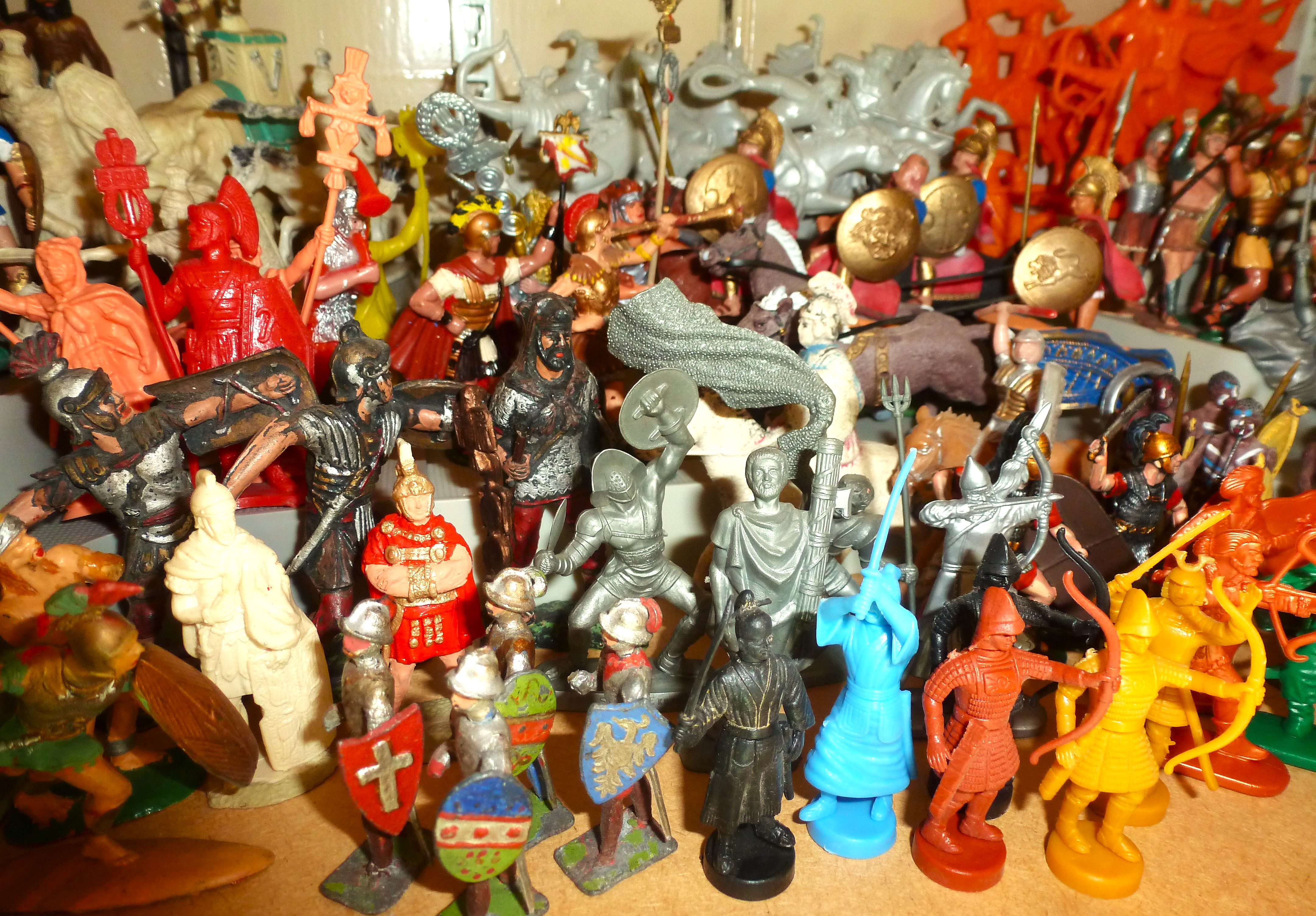
Medieval figures on display.

 Slowly getting around to putting figures back on display after they had to be packed away for work on the house a few years ago, a change is as good as a rest and it's good to see them out again.


Medieval figures always add a good splash of colour and and these are some of my favourites, lots of conversions and some will get pulled out from time to time to serve in a wargame but mostly their purpose is to please the eye.  

The Playmobil ship is crewed by Einar and his men from "The Vikings" movie, as portrayed here in plastic by the French firm Ougen, Matt Thair has now produced the set in metal and you can see it here: White Tower Miniatures  


The castle walls and towers are from a Foreign Legion fort gifted to me by another friend Barrie Blood who commissioned it from a chap called John Russell, who exhibited his wargame buildings at the first Plastic Warrior Show and built the Spanish Town shown in the previous post One Hour Wargames - Double Delay

 The fort was built in scale for 54mm toy soldiers and rather large so I solved the storage problem by incorporating it into this display, it should come out without to much difficulty if needed for a wargame.


In the foreground an assortment of figures made in Poland by PZG (Polski Związek Głuchych - The Polish Association of the Deaf), rear right a mounted knight made in Italy by Nardi and Joan of Arc made in France by Starlux.


Two Elastolin siege engines, behind them a group of crossbowmen made in France by RF (Rene Fisher).


Lords and Ladies of the Court, too many to list but included are figures by Elastolin and Starlux with many conversions and also a few chessmen.


More conversions with a resin model of Joan of Arc (mounted) sold in France as a tourist item.


Some folk heroes are dotted around in this corner, including Robin Hood figures made in England by Crescent and Italy by Res Plastics, some of the Wiliam Tell set from REAMSA of Spain (Resinas Artificiales Moldeadas S.A.- Moulded Artificial Resins Ltd.) and yet another Joan of Arc on foot which is a Starlux conversion.


In another corner the musicians and jesters strike up the band.  The larger yellow jester was made in Germany by Heinerle, Manurba, Domplast (take your pick) the smaller one beside him is a ceramic knick knack and the seated piper is a shepherd boy made by Elastolin.


In the foreground a group of crossbowmen made by Res Plastics and offered in Kinder Surprise chocolate eggs, there are four figures each with different styles of armour, pavise and bows.


In the foreground various footmen made by Starlux, behind them Edward The Black Prince is a Starlux conversion made by Vince Mattocks and the mounted knight to his right was made in France by Guilbert.


In the tower are three figures from the Alexander Nevsky set made in Russia at the Progress factory in Moscow, I bought these at the second Plastic Warrior Show back in 1987 from a chap who was importing figures made in the old Iron Curtain countries, I think he was the only dealer at the show that year.  To the right of the standard bearer is the portrait figure of Albrecht Gessler from the William Tell set made in Spain by REAMSA (Resinas Artificiales Moldeadas S.A.- Moulded Artificial Resins Ltd.), this is the later reissue made by Oliver.


You can never have enough archers, the front row kneeling are Starlux behind them are mostly figures by Rene Fisher.

Saturday, 20 September 2025

Other plunder from the Plastic Warrior Show 2025

 I've been going a bit overboard with the medievals this past year or so, to the detriment of collecting other historical periods, but I haven't neglected them entirely:


My last sweep of the show turned up these four odds and ends for just £1 each, two late version French Revolutionaries made in France by JIM, a Crescent Russian for my Winter War project and a large resin touristy tat knight, not really my thing but I just loved the pose.


The PW Show has always been as much (if not more) of a social occasion than anything else, for many who attend it's the one day of the year they get to meet face to face with friends they've known for many years and there is often a gifting of figures.

Graham Apperley gave me the first two, a cowgirl on bucking bronco made in USA by Beton (Bergen Toy and Novelty Co) and a Gaucho made in Argentina by EGToys (Ezio Guggiari) who were producing these distinctive figures between 1943 and 1965, 

Michael Mordaunt-Smith gave me the red plastic figure of Jim Hardie from the 1950's American tv series "Tales of Wells Fargo" which he is currently producing from an old mould, the original figure was made in America by Louis Marx but the consensus of opinion is that this is a copy as it is noticeably smaller. 

The 70mm green figure of Sir Gawain was made in Spain and is very similar to, but not a copy, of the figure made by Elastolin for their Prinz Eisenhrz set, based on the Prince Valiant comic strip created in America by Hal Foster. It was given to me by Paul Stadinger (aka Stad) who at one time was the U.S. agent and distributor for Plastic Warrior magazine, and has been attending the show regularly since the 1990's. 

This group above came from Andreas Dittmann another regular long term visitor to the show from Germany, an Elastolin trumpeter, Lineol grenade thrower, a pair of plaster sheep with a lamb and an early post war East German infantryman made in a papiermache/plaster composition mix by PGH Effelder.

My thanks go to Graham, Michael, Paul and Andreas for their kind gifts and the many years of friendship we have shared. 

And finally......this was actually my first purchase of day, an Art Deco Renault tank, carved in wood, roughly in scale for 54mm figures, the consensus of opinion was that it had been manufactured commercially rather than being "shedware".  I'm tempted to paint it, but I won't!

Wednesday, 14 May 2025

Assorted Ancients now on display.

 Following on from the previous post, here are closeups of the second new shelf.  The shelves are inside a pine wardrobe built into a chimney alcove, long since unfit for purpose but I'm averse to ripping out period features so it now houses toy soldiers and the original doors provide some protection from the dust.


In the background are a group of  Neanderthals made in France by Starlux.  

In front of them are hoplites made in Greece by PAL and later versions made by Athena (Aohna), the easiest way to tell them apart is the earlier PAL figures have a flat square base with no markings underneath while the Athena ones have a sculptured base marked Aohna underneath, the PAL versions also have metal pins attaching their arms.  

In the left foreground are Greeks/Romans made in Italy by Tibidabo (green bases) and to their right are two made in France by Clairet (tan bases)


In the centre, various Roman signifiers by Atlantic, REAMSA, Marx and Elastolin, in front of them are three large rubber figures made in Italy by Xiloplasto.


The large colourful figure in the sentre is one of the Louis Marx Ancient Chinese Warriors.  The large blue Romans beside him are reissues made in Spain by Oliver. 


The two Samurai at rear left were made in Poland by PZG (the Polish Association of the Deaf), in front of them are Ancient Egyptians made in Spain by Jecsan, with more Samurai to the forefront, these ones made in Italy by Res Plastics for Kinder eggs.


A better view of the Res Plastics Samurai, I started picking these up with the intention of creating a wargames army with them but the fiddly parts and loose weapons made them impractical for this, so they are now consigned to the shelf and my Samurai armies are now made up from Technolog, Furuta, gashapon and various kit figures.


In the centre the unpainted Roman and Tribune in red cloak were sculpted by Peter Evans and cast in Resin by Peter Cole (before he set up his company Replicants to make figures in plastic), the idea was that they would make additional poses to go with the Louis Marx Ben Hur playset which had just been reissued from the original moulds by a company in Mexico.  

To their right are two coffee premiums made in Belgium by Cafe Storme.

The four Carolingians marching in the foreground are 45mm solid lead figures made in Germany by Heyde.


The large mounted Roman on the left was originally made France in hollowcast lead by JSF (Jouets Standard Francais), this is a plastic version made form the original mould.  On th right next to him is another mounted Roman, made in Hong Kong it is a copy of a Crescent foot figure on a copy of a Herald horse.


This is the set of four made by Res Plastics for Kinder eggs, they are often described as being Samurai but I am advised (by someone to knows vastly more than I do about ancient armour) that they are in fact Ancient Chinese (they still look like Samurai to me, what do you think?)