Showing posts with label Boardgames. Show all posts

Wednesday, 21 May 2025

Lionheart - A Medieval Wargame with 54mm toy knights

 Our first trial of the boardgame Lionheart worked very well so we decided to expand on it by introducing some terrain elements and an additional two unit types; Heavy Foot Knights and Mercenaries. The remainder of the armies were the same as in our previous game and we increased the number of actions in each turn from four to six per side.  The basic game mechanics were explained in my previous post HERE.


The French line up with Heavy Foot Knights on the left flank (just visible at the top of the pic) and the Kievan Mercenaries on the extreme right.  For the Mercenaries we used Medieval Russian Knights made in china by Supreme along with some made in Russia by Engineer Basevitch.


While the English line advances with Heavy Foot to the front (Britains Deetail knights just beyond the Timpo Crusaders) and Irish Mercenaries with their priest following in support.


The game allows for one more unit type; Peasants, but I didn't have any suitable figures to hand so we left them out, maybe they'll appear next time.


With their enhanced mobility it's always difficult to hold back the Mounted Knights, they charge across the field when they see an opportunity to strike.  This invariably draws out their opposite counterparts and leads to a duel between the chivalry.


  The Mercenaries are strong in combat and have the ability to induce panic in any unit they attack, forcing them to retire, the danger is that they can be turned if they come in contact with the enemy King and may change sides.


The terrain comprised a line of hills with a road running through them on one flank, a central plain and a forest with a road running through it on the opposite flank.  I like to keep things simple to begin with.


The Heavy Foot Knights (centre) are powerful in combat but very slow moving, it takes two actions to move them one hex, as a result they never really got into the game.
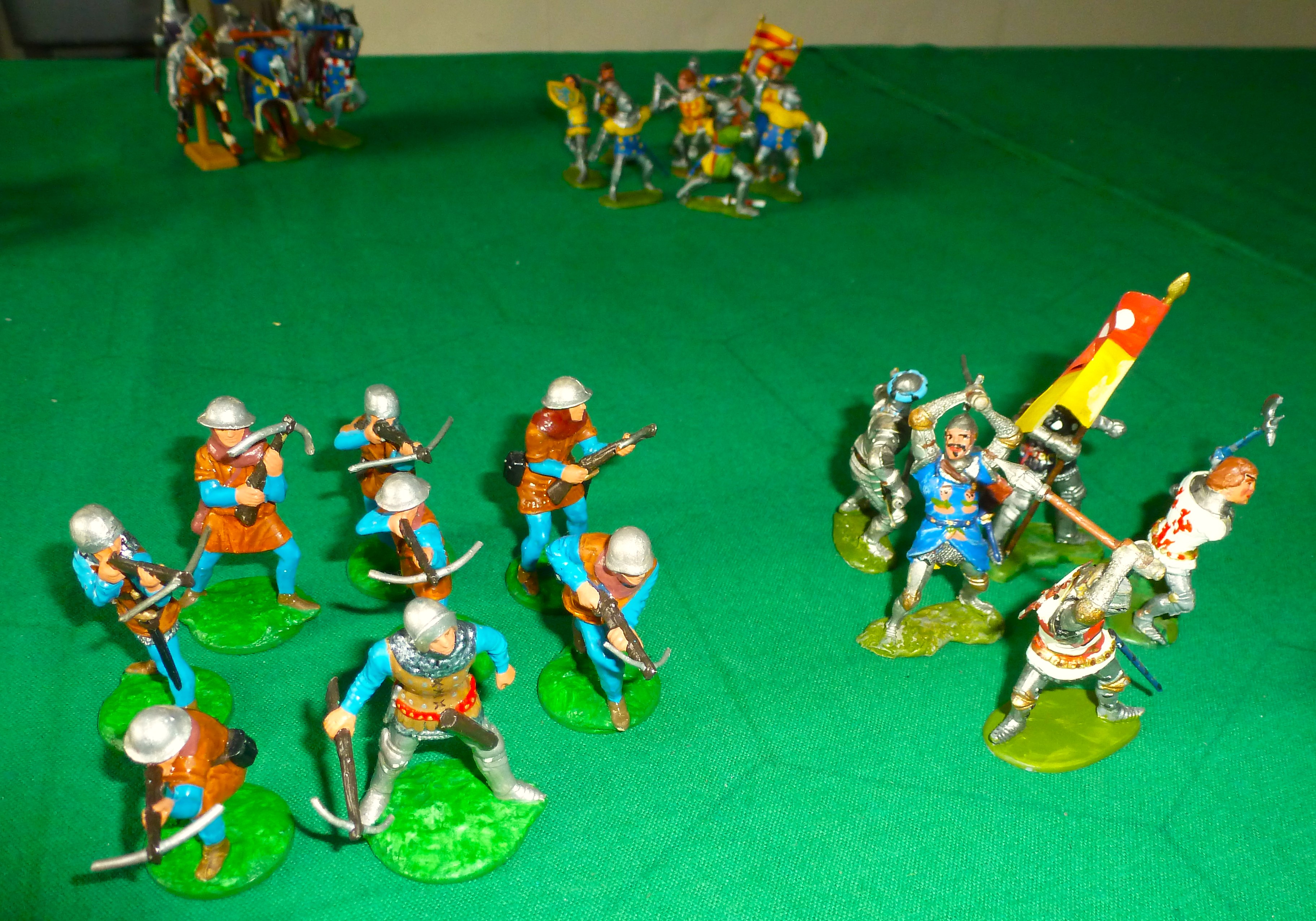

After the Mounted Knights had exhausted themselves duelling the Infantry and Archers moved in, the latter being quite vulnerable if attacked so need close support.


The Kings and their retinues tends to become a mounted reserve, kept safely out of the way behind the lines until desperation draws them out into the fray.


As things turned out all of the action took place in the central plain and virtually no use was made of the hills or forest.  (Note to self: put more obstacles in the centre of the field next time)


I always pick up bits and pieces of Timpo medievals when I see them in the cheap junk boxes at shows, they invariably have no weapons, scabbards or shields but that's easily sorted.  They are notoriously unstable on their small green bases so I mount them on 2p coins, this will be anathema to some people but lets face it they're not rare, you can find hundreds of them on the internet auction sites every day of the week.


This time the game was much less cohesive with small groups of opposing units engaging in clumps of combat dispersed around the field.


It's a good game system and I like the way it flows, I think we will need to give more thought to how we deploy the Heavy Foot Knights or revisit the way we allocate actions in each turn.  

With a little tweaking the system could be easily adapted to the Dark Ages or brought forward into the Renaissance, so we might have a go at one of those periods sometime.

Monday, 10 March 2025

Woking Wargames Day 2025

 Last Saturday a small band of the faithful from the Little Wars Revisited group assembled in Woking for this years Games Day.  The event was hosted by Mike who offered us three games using 54mm toy soldiers including Waddington's Battle of the Little Big Horn (seen on this blog previously).  I took part in a Battle Masters Lord of the Rings game and here's how it went:


Anthony provided all the figures and umpired the game, this is the starting position with the forces of Middle Earth on the left and the Hordes of Mordor on the right.


The forces of Mordor included this rather fine Ogre, I don't know who he's made by but he certainly looks the part.


The figures used are mostly Britains Deetail knights with minimal repainting and relevant heraldry to distinguish either side, I was very taken with the quality of the basing.


The dark forces included Orcs and Uruk-hai from Britains recent metal LOTR range.


This rather nicely designed terrain matt comes with the original MB Battle Masters boardgame.  The firing system for the trebuchet on the left was fun if a little erratic. but very effective when it hit home.


The Mordor cavalry, Britains Deetail Saracens looking suitably sinister in red and black.


The Ogre is slow to get going but unstoppable once he starts, he gave my horsemen a real pasting!


Audience participation was less than hoped for.


Regular players Patrick and his son William brought along their collection of Anglo-Norman figures for the 1135-53 Civil War between King Stephen and Empress Matilda


The game was a Norman skirmish using the Song of Blades and Heroes rules, the figures are 54mm metal made Irregular Miniatures and you can see more of them on Patrick's website here:  Patricks Wargames

Saturday, 2 November 2024

Lionheart - a medieval wargame with 54mm toy soldiers

 Lionheart is a medieval boardgame published by Parker Brothers in 1997, played on a square grid with 25mm pieces the aim is to capture the enemy King or destroy all of his army, it plays a bit like a game of chess.  We thought we'd try out the basic game to see if it would translate to a wargame with 54mm toy soldiers, here's how it went:


The English left wing shown above and the right wing pictured below, the basic game has 4 unit types: The King, mounted knights (2 units), infantry (5 units) and archers (2 units).  For visual impact we doubled the number of figures in each unit, so the King got a standard bearer, each mounted unit was 4 figures and foot were 8.


There is an advanced version of the game that includes 3 more unit types: heavy foot knights, peasants and mercenaries but we left these out this time as we were just looking to test the game mechanics.  One major change we did make was to play on a hex grid rather than a square one but this doesn't make any significant change to the dynamics of the game.


The French left wing shown above and the right wing pictured below.  Players dice to see who goes first and then play on I go U go basis, as we'd doubled the number of figures in play we also doubled the number of actions allowed each move from 2 to 4.  The actions allowed are: Move, Turn, Attack and the limit of 4 actions applies across the whole army not unit by unit, actions can be taken in any order i.e. 4 units could make 1 move or alternatively 1 unit could move, a second could turn while a third moved and attacked.


All units move in a straight line, mounted (King and knights) can move any number of hex for 1 action but foot units (infantry and archers) only move 1 hex for 1 action.  No interpenetration through other units is allowed.


Archers can fire over friendly units and their range is anywhere in the arc of the 9 hex in front of them (2 hex, then 3, then 4).  All other units attack when they move into direct contact with an enemy unit and have an action remaining to enable the attack i.e. for an infantry unit to move 2 hex and make an attack costs 3 actions.


The game uses 6 sided dice with symbols: 3 x Axe, 2 x Arrow and 1 x Panic.  We used ordinary D6 with 1,2,3 = Axe, 4,5 = Arrow and 6 = Panic.  A D6 is thrown for each foot figure in a unit and 2 x D6 for each mounted, so a maximum of 8 x D6 for each unit.  Archers register a hit for every Arrow thrown, all other units make a hit when an Axe is rolled, casualties are removed: foot for 1 hit and mounted for 2 hits (rounded down).  Combat is completed one unit at a time and hits are not cumulative.


If 4 x Panic dice are thrown the the unit attacked must turn and retreat one move i.e. a unit of 8 infantry attacks an enemy infantry unit, it throws 8 dice and scores: 3 x Axe, 1 x Arrow and 4 x Panic, the unit attacked suffers 3 casualties then must turn and retreat.


We found the rules very quick and easy to assimilate, the game flows fast and smoothly.  Foot units advance rather ponderously and need to be supportive, a unit that becomes detached is liable to be picked off and overrun by enemy cavalry.  On both sides archers made up 20% of the total units, so a decent representation but not enough to dominate the field and turn the game into just another shooting match.  The mounted units are very much the arme blanche of the game, sudden sweeping charges packing a devastating punch, just as it should be.

We didn't include any terrain features but there is provision for this.  Going forward I think we will take scenarios from One Hour Wargames, or perhaps based on historical events and introduce the additional 3 unit types (heavy foot, peasants and mercenaries).  The simplicity of the rule system and lack of any record keeping also means that we could easily double the number of units and actions per turn to make it a much bigger game.  It would be interesting to try an Agincourt scenario, with the flower of French chivalry facing a wall of English archers!

 Apart from the Timpo crusaders, which have been based to give them more stability on the table.
all the rest of the figures are conversions, mostly from the talented hand of modeller and heraldic expert Vince Mattocks,

Friday, 14 January 2022

Rojas y Malaret Battle of Metauro revisited

 In the closing weeks of last year Anthony and I decided to take his 54mm Battle of Metauro game for another spin, originally this was a board game made in Spain by Rojas y Malaret, Anthony took the original board and had it blown up as a gaming mat for 54mm toy soldiers, here's how the game works: (click on the images to enlarge them)


With the German (Hausser) version of the game you could purchase additional extension packs to increase both the number of figures on the board and also the variety of troop types, such as archers, light infantry and Gallic allies.  Accordingly, Anthony has been building up his collection of DSG Roman and Carthaginian forces in line with the expansion packs available for the original game.


The game opens with troops being placed on the squares with coloured triangles (each individual figure represents a unit), each square can contain 3 infantry, 1 infantry and 1 cavalry, 2 cavalry or 1 elephant.  You can have less figures on a square but you can't exceed these numbers per square, this can have an important impact on movement and combat later in the game.


Movement distances are 1 square for infantry, 2 for elephants and 3 for cavalry.  Woods and ruins provide cover and can only be entered by infantry.  Squares with rocks are an obstacle, they can't be entered or passed over by any troop types. Infantry in cover get a bonus in combat.


A unit moving into a square adjacent to a enemy must attack, combat takes place between individual units and the attacking player decides the order of combat, both sides roll a D6 to decide the outcome.  Highest score wins, 1, 2 or 3 have no effect, 4 or 5 cause the loser to retreat 1 square (2 squares for elephants), 6 is a kill and the losing unit is removed from he board.  If both sides get the same score (including bonus modifiers, see below) there is no effect.  A unit can only take part in combat once in each move turn.

There is no bonus for the attacker but infantry in cover get a +1 added to their score.  Cavalry always get a +1 in combat while elephants get a +2.  Only the Carthaginians have elephants (obviously) but to even things up the Romans get 3 designated figures who can attack and force the elephants to retire. 
 

Rivers can only be crossed at the fords indicated by stones, the central rocky plateau (shown here in orange) counts as cover for infantry, the rocks on three sides around it are impassable.

After combat, a losing unit forced to retire must move into the square directly behind it (elephants retire 2 squares), subject to that square being accessible to the retreating unit type and having enough space to accommodate them i.e. a cavalry unit can't retire into woods or into a square containing 3 infantry, 2 cavalry or 1 elephant, but can retire if the square is empty, has 1 infantry or 1 cavalry on it already.  If the losing unit cannot retire onto the square behind, it is destroyed.  This can be particularly problematic with elephants, you need to keep plenty of retiring space clear behind them!


After each individual unit combat, if one unit is destroyed or forced to retire, the the victorious unit can choose to occupy the vanquished enemies place on his square.  

E.g. 3 Roman infantry move up to an enemy square containing 1 infantry and 1 cavalry. The Roman commander chooses one of his infantry to attack the Carthaginian infantryman, the dice scores are 4 against 3 so the enemy infantryman is forced to retire and the victorious Roman moves into his square, beside the Carthaginian cavalryman.  Next he chooses the second infantryman to attack the Carthaginian cavalryman, the dice scores are 4 against 5 but the cavalryman has a +1 making 6 so the attacking infantry unit is destroyed and removed, but the victorious Carthaginian decides to stay where he is and not occupy the Roman infantryman's square.  Finally the Roman commander uses his third infantryman to again attack the Carthaginian cavalryman, who can't fight back because he has already been in combat this turn, the Roman throws D4 forcing the cavalryman to retire and moves into his square.  

At the end of this move turn this leaves the 2 Roman infantry in the square adjacent to the Carthaginian infantry and cavalrymen who have been forced to retire.  It is now the Carthaginian move turn and they must attack the 2 Roman infantry units in the adjacent square, both side are effectively pinned.  If the victorious Roman units had not advanced into the vacated square during the last round of combat described above there would have been a gap between both sides and the Carthaginian units would have been free to redeploy.


The game is won by killing your opponent's General or occupying both of the camp squares on their baseline.  

Simple, quick play rules, easy to learn but with subtleties that can cause a few unpleasant surprises, the game system is very well suited for use with 54mm toy soldiers and increasing the number of units in play adds greatly to both the visual impact and tactical opportunities.

In our previous game we tended to try and occupy the areas of cover which dominate the centre of the board in order to acquire the +1 combat bonus for infantry and it became a bit of a slugfest there with the mounted units dancing around on the periphery.  In the game pictured above the Carthaginians allowed the Roman infantry to occupy the ruins in strength and left cavalry units hovering around to block any attempted breakout, effectively turning the ruins into a POW camp.

Tuesday, 17 August 2021

Rojas y Malaret Batalla del Metauro

 From the same stable as the Battle of the Little Big Horn game that Anthony and I played back in June comes this Punic Wars game based on the Battle of Metaurus.  Originally designed and published in Spain by Rojas y Malaret, as part of a series of games called "Great Battles of the World" then subsequently produced under licence in Germany by O.M.Hausser.

This is the box art for the German version of the game, which Anthony acquired and then had the board copied onto a 6'x4' mat so that we could play it using 54mm toy soldiers.

It's a different layout to the Little Big Horn game but you can see that the graphics are the same style.  This is the Carthaginian end of the board, forces start with the river behind them and on the base line behind the river, either side of the tree, are two standards, the object of the game is to kill the enemy General or capture both standards.  Possession of the elephant should have been a game winner, sadly I proved to be no Hannibal!

At the Roman end of the board the troops start off in wooded country and have two cavalry units, pitching mobility against the greater combat strength of the Carthaginian elephant unit.  In the centre of the board there is an impenetrable mountain range with surrounding woods and an area of ruins.

Terrain features such as woods, ruins and the mountainous areas in orange are accessible only to infantry, but the lines of rocks are unpassable to all.  These features provide cover and give a combat bonus to the infantry occupying them.  The river can only be crossed at the three fords.

The figures we used were 54mm Romans and Carthaginians made by DSG of Argentina.  The dark line running across the board is just where the original board was folded, it has no bearing on the game.  

The ruins in the centre of the board became the focal point of the battle and changed hands several times.  The trees, rocks and ruins don't come with the game, we just added them to improve the visual aspect.

The Roman cavalry were put to good use running rings around the slower moving Carthaginians.  We played the game using the original rules and numbers of  figures, combat and movement are similar to the LBH game so very easy to pick up quickly.  With the original game you could also buy add on units to represent different troop types and there was also an additional rule for combat with elephants.  The game took about an hour to play and going forward we agreed that it would give a more challenging and better looking game to increase the number of figures used.

This is the contents of the Hausser box, the infantry and cavalry are 40mm Elastolin figures, they incorporated the original elephant made by Rojas y Malaret from the Spanish version.  This box has had an add on set included as the Metauro game only came with one elephant, there was another game based on the Battle of Zama, which had two elephants.  The Zama game also has a different board layout, it is played across an open area with stockade encampments at either end.

These are a couple of the figures from the original Rojas y Malaret game, the infantry (which I couldn't find when photographing this) are a bit over 54mm, the riders here are 54mm but you can see that the horse and elephant are not to scale.  The elephant is a solid one-piece plastic moulding.

Saturday, 26 June 2021

Waddingtons Battle of the Little Big Horn with 54mm toy soldiers

Anyone who was a schoolboy in the 1960's will remember the Waddingtons board game of the Battle of the Little Big Horn, it came with some rather nice 40mm figures of General Custer, his 7th Cavalry and the opposing Sioux and Cheyenne Indians.  Well sometime last year Anthony had the original board copied onto a 6'x4' mat for use with 54mm toy soldiers but the ensuing pandemic has prevented us playing it, until today, which by the purest of coincidence happens to be the 145th anniversary of the actual battle.


The Indian camp beyond the Little Big Horn river, the red triangles show the starting places for the Braves on foot, the blue triangles are the starting positions for Custer and the 7th Cavalry.  Model trees and tepees give a bit of definition to the flat board.


At the other end of the board the red triangles show the starting places for the mounted Indians and their Chiefs, rock formations give a 3D effect to the board.


The figures we used were from the Britains Deetail range, the beauty of these is that they have metal bases which prevent them falling over all the time.


Victory conditions for the 7th Cavalry is either to escape across the river and exit the board with their flag or kill all of the three Indian Chiefs.  Victory conditions for the Indians is to kill Custer, his two officers and capture the flag.
 

We played a trial game with the original rules and number of figures, we were surprised at how subtle and tactical the rules were, mistakes were inevitably made on both sides but in the spirit of good gamesmanship we helped each other to avoid the most disastrous outcomes.  The game took about two hours to play and as you can see above it reflected the historical outcome.  It was great fun, surprisingly challenging and we felt the game system could easily be adopted to other low intensity irregular conflicts, I already have a late 1940's French Indochina project in mind.


For those who like a bit of toy soldier trivia with their wargame reports this is the first version Zang/Herald tepee from the Indian encampment set.  I don't know if you should call this rare or just hard to find but it differs from the ubiquitously common second version by having a short entrance flap with four diamonds above while the later one has a larger flap with just two diamonds above.  Not many people know that.  You really do have to be a boring old fart to be interested in this sort of minutiae! 

And yes, it really was a complete coincidence that we played this game on the anniversary of the actual battle. We got so drawn in we could almost have been there on that fateful day in 1876, imagination can take you to these places, good job they don't let children get a taste of it.