Showing posts with label tinplate. Show all posts

Wednesday, 7 May 2025

Britains American War of Independance Swoppets.

 This past year I embarked upon a review of how I store and display the unruly mass of toy soldiers accumulated in a largely haphazard way over the past six plus decades.  


Everything is being separated out between collectables and figures for wargaming, the former to stand safely on a shelf gathering dust and looking pretty, the latter boxed securely in their units and ranks ready to be deployed on the tabletop at a moments notice.


I started picking up Britains and Timpo American War of Independence Swoppets with the intention of using them for wargaming, back then they were the only figures available for the period, but they were hard to find and by the time I'd acquire enough they were getting too brittle and delicate for the amount of handling involved.  I aught to let them all go but I don't feel quite ready for that yet.


The building in the background is the tinplate "Revolutionary War Tavern" made in America by Louis Marx, the mounted figure of George Washington to the front left of it is an old composition piece made by Elastolin.


In amongst the Britains and Timpo Swoppet AWI are a smattering of figures from other manufacturers such as: Shell Liberty Men of '76, Louis Marx Warriors of the World, A Call to Arms, Res Plastics for Kinder Eggs, Awesome Toys, Casualties of War, Airfix, and a couple of white metal models.


The building shown here is the Louis Marx tinplate "Civil War Mansion" from their "Battle of the Blue and Gray" playset.


Native American allies are provided by Mohicans from Britains Herald range and Charbens.

 These figures have all spent far too long languishing in boxes so it was nice to get them out and put on display where I can appreciate them a bit more.

Wednesday, 10 March 2021

Beautiful Big Battleships

 I recently unearthed these photos I took a few years back of a rather fine model battleship, it was in the window of a high end antiques gallery just outside Hastings in East Sussex, the place was shut and I wouldn't be able to get back there later so I had to take the pics as best I could through the glass.  The model was about eight feet long (from memory) and I thought it was amazing, but I know nothing else about it.  Does anyone recognise the ship? the four smoke stacks might give a clue, could it have been a shipbuilders model or a film prop?  I have no idea but I thought, if I like it, then maybe someone else will too, and I think it's too good an image to leave forgotten on an old memory card.  Double click the pics to see the detail, it's taken a lot of punishment over the years but not beyond restoration I think.


In this pic you can just see the stern of another battleship.


Just to add to the confusion, I think this may be a photo of the second battleship mentioned above.

Yes, definitely a second ship, again with four smoke stacks but I think this one was a bit shorter.

When I look at the damage strewn across the decks of  these old models it makes me ponder on the carnage left in the aftermath of a sea battle between such steel leviathans.

Friday, 10 July 2020

Toy Soldiers of the Great War

An early birthday present to myself (because I'm worth it), "Les Petits Soldats de la Grande Guerre" has been out for while but I've only just come across it, the cover announces that it includes 800 toys of WW1 so I had to have it.


Published in 2013 by Editions Glenat, A4 format, it has 256 pages illustrated in full colour throughout, ISBN 978-2-7234-0700-2.  Written in French only but light on text so not too challenging for anyone with with a smattering of the language and a grounding in the Great War.  The pic below gives an example of the layout and quality of the illustrations.  The cover price is 39 Euro, which I would say offers very good value for a book of this size and quality, I got my copy on ebay France, new and still in the cellophane wrapping for 19 Euro plus 9 Euro P&P from seller "Book77".  Bargain!


There are 12 chapters looking at different aspects of the war, into which the toys are conveniently slotted.  The cover gives little away and I half expected the book to include every type of toy from diecast vehicles to dolls and teddy bears, but fear not, apart from a chapter containing tinplate tanks and ships the rest is all toy soldiers.  

You can expect to see the perennial favourites from Britains, CGB Mignot, and Elastolin  but they don't dominate, it's packed with figures of every genre: paper, flats and semi flats, conjoint tin, wood, hollowcast and solid lead, composition and even a little plastic and modern white metal (but not much).  The more I flick through it the more I enjoy it, I reckon you will too.


Sunday, 12 May 2019

Well that's all done for another year!

Yesterday was the thirtysomethingth Plastic Warrior Show in London, I forget which number we're up to, a sure sign of ageing), here are a few of the things I took a shine to:


A tongue in cheek diorama made by Dan Morgan shows the archaeological discovery of  ancient Replicants figures in the South Downs of England.  The archaeologists are all converted from Replicants wild west figures.


The Plastic Warrior Show has become the traditional showcase chosen by Replicants to launch their latest range, this year they have produced a set of Texas Rangers.  Not the sharpest photo, sorry about that.


It's not all plastic at PW (although it is mostly), here a nice selection of Elastolin and others composition, I thought the bears were awesome.


One of the nicest forts I've seen in a long while, this one hand built by the seller, if only I had the room for it..............


I love these early plastic aircraft, especially the twin engine bombers, I'm tempted to start collecting them but you have to draw the line somewhere........don't you?


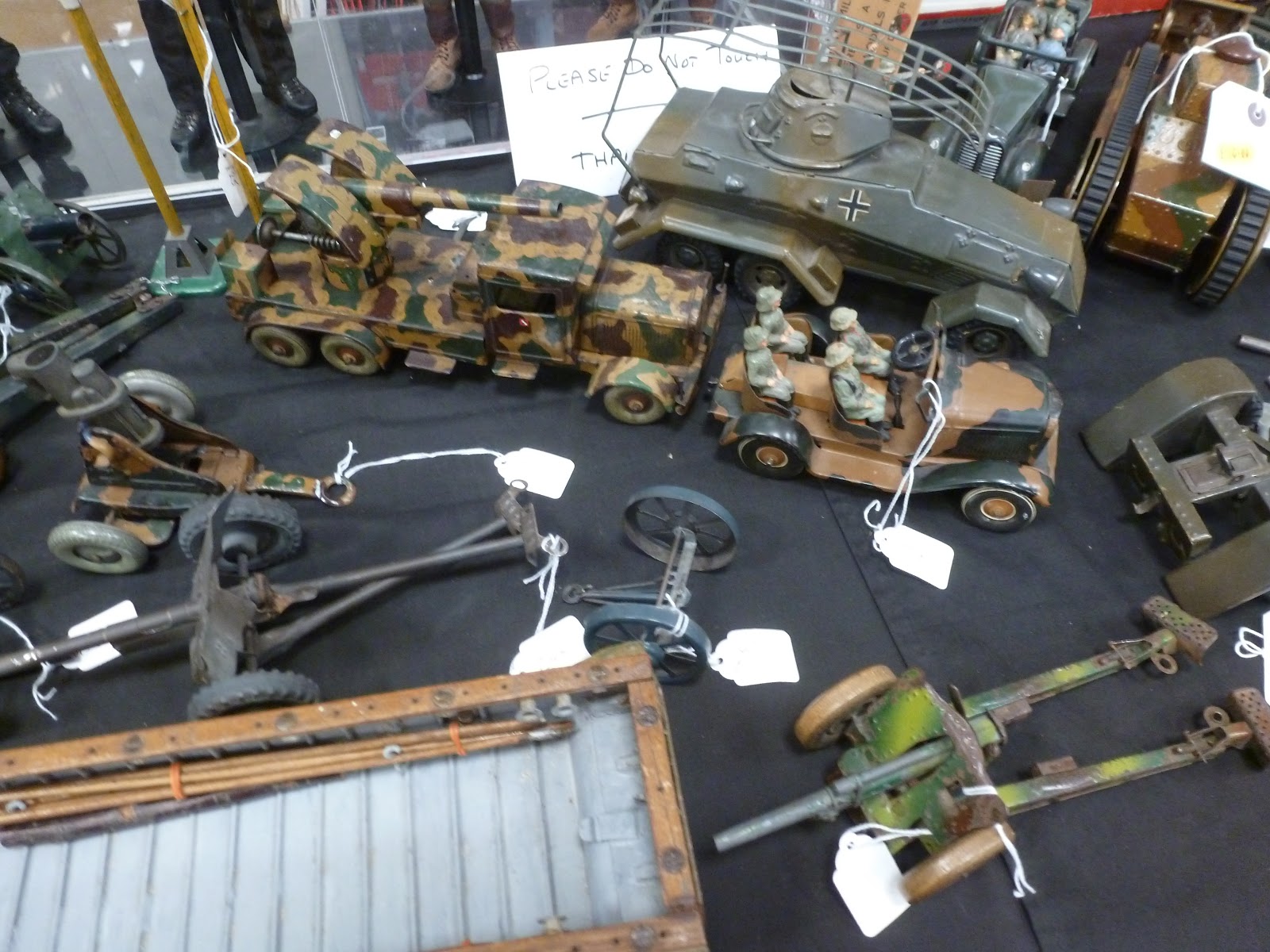
Some serious hardware here, lovely old German tinplate from the 1930's, the AA truck and jeep in the centre are by Tippco, I didn't dare to turn over any of the price tags!


More from the same table, the panzer in foreground was made by GAMA, I don't recognise the large gun at the back but it looks to be like 1960's manufacture.


A typical table top at the show, an organised confusion of plastic figures, this table belonged to one of the German collectors.  Last year we had wondered what effect Brexit would would have on the attendance of dealers from Continental Europe, happily they all booked their tables way before Brexit was postponed, which bodes well for the future, it seems the lure of toy soldiers far outweighs a little inconvenience at customs.  The German guys were all staying overnight in Belgium so they could attend the Brussels Toy Soldier Show the next day......... and there was a spare seat for me if I wanted to go, was I tempted?  you bet I was.


A nice selection of rare and early English plastics, it continues to amaze me how much of this stuff there is out there.  We all acquire far more toys than we need or want and the PW show has always been primarily aimed at collectors who want to dispose of their surplus, this year the show was fully booked well in advance and there was a sizable waiting list in the event of any dropouts.  I find this very encouraging, it indicates an enthusiastic and resilient collectors community.

Sunday, 28 April 2019

It's surprising what turns up.

The recent mild weather in the South East (UK)  has ushered in the start of the Car Boot Sale season a little earlier than usual.  Our local one is held on a farm, so it's a good long walk in the early morning fresh air, and I like to go along as often as I can for the exercise.  Who am I kidding, I go along for the bacon rolls and to hunt toy soldiers!   It can be very hit or miss but  here's what I picked up this week and last:

A group of modern white metal figures the first one depicting Captain Souter of the 44th Regiment of Foot could have walked straight out of the Last Stand at Gandamak painting by William Barnes Wollen.  The other five are from a range of 150 figures issued with the Hachette publication La legion Etrangere, available in France but not in the UK so they are harder to find here, I use them mostly for uniform research and at less than £2 each they had to come home with me.

I know nothing about old tin toys, except that I like them, and I do like to include them as set dressing in wargames.  The saloon car is about the rights size for 54mm toy soldiers while the Omnibus is a bit small but I think we'll get away with it, they both need a bit of cleaning up and straightening out but nothing too drastic.  I don't think there's any great age to them, they look like modern reproductions to me but for a couple of quid each they had to go in the bag.  Likewise the ceramic stable block which was made to take a tea light candle but will now illuminate my toy village.

Finally a hotch-potch of odds and ends that came in at about 50p each from various junk boxes.  The first three Britains/Herald Robin Hood figures are so damaged and scuffed that they will end up as conversion fodder.  The Evzone and horse from the Lone Star Lone Ranger figure will be passed on to someone else at the forthcoming Plastic Warrior Show next month.

The remaining two figures I'll keep, the chap in green is a Starlux character figure of Barberousse (Red beard) from the ORTF (Office de Radiodiffusion Television Francaise) TV series Richard Coeur de Lion.  The set was issued in the mid 1960's and included two foot figures each of Richard, Redbeard and Blondel and one mounted figure of Richard, they're quite hard to find.  The diminutive figure of Napoleon was made in France by MDM.  The palm tree is a modern white metal item.

The Plastic Warrior Show is being held on Saturday 11th May and further details can be found on the Plastic Warrior blog, link in the column to the left.  Good Hunting!

Monday, 4 June 2018

One Hour wargames - Smolensk 1941 with 54mm toy soldiers

At the weekend Anthony and I got together for our fourth game using the One Hour Wargame rules. Flushed with the success of our Napoleonic game we felt ready to take the next step and devise our own scenario, I chose to base it on the First Battle of Smolensk in July 1941.  We aren't sticklers for accuracy but do want the thing to feel right so the Germans had to be light, fast, hard hitting and cohesive while the Russians would be steady, solid, and hard hitting but uncoordinated. It's been a long time since I've played a  WW2 wargame with 54mm toy soldiers, here's how it turned out:

The German motorised units deploy to force a bridgehead across the river Dneiper. A reconnaissance unit dashes across the bridge, supported by elite assault troops, heavy and light tanks, antitank, mortar and two infantry units. A total of eight units, see note at end of post for further explanation about troop types.

The Russian defenders lie in wait; on the left, infantry in the woods backed by a unit of heavies, blocking the road to the bridge is an antitank gun, behind it KV1 and KV2 tanks are hull down on the hill, behind them the Guards division is held in reserve and the mortars await firing instructions. On the right two more units of infantry and two of navy have take up position in the woods and ruins of the city's suburbs. A total of 12 units.

A very strong position with defence in depth, the winner will be whoever holds the hill (where the tanks are stationed) after 15 turns.  In the actual battle the Russian forces put up a strong fight with fierce counterattacks but a weak command structure meant that they were poorly coordinated, to represent this we used the Shambolic Command rule (see here) so that the Russian Commander could only move or fire up to four units each turn.

The bridge is a vintage tinplate railway piece made in Germany by Gebr. Bing (Bing Brothers) around 1900, these usually sell for about £60 but this was in such poor condition I got it for £1 (about 20 years ago) I finally got around to stripping and repainting it for this game (there's nothing like a deadline to get things done). I painted it as a road bridge because the rail gauge is too large to go with the British made Triang railway tracks that I have.  The wooden western town buildings represent a peasant village or dacha (or something like that)

The badly mauled reconnaissance unit veers off the road to make way for the Pzw II and Stug following in support.

The Pzw II is a vintage piece made in Germany during the 1930's by GAMA, I thought it looked right at home in this setting.

The infantry have effected a river crossing by boats, just as they did at Smolensk in 1941, to represent this each unit must first advance to the river bank then next turn it can dice to activate the crossing by achieving 6+ from a throw of 2xD6, if it fails it remains where it is. Needless to say, only infantry on foot can cross like this, vehicles must use the bridge.

Units can move or fire in each turn but not both, apart from the mortars they all have a firing range of  2 feet.  The mortars have a range of 8 feet but needs a friendly unit to spot for them, the spotter needs to be within 2 feet of the target and have clear field of sight to them.

The two Russian naval units occupied the suburbs of the city, here represented by Airfix Strongpoint buildings which have been enhanced with fallen rubble and collapsed rafters.

Heroes of the Soviet Navy scramble through the ruins. The individual figures are mounted on metal bases which enables them to stand on uneven or sloping surfaces and prevents the tumbling domino effect. To make two distinct units I painted all the riflemen as white jackets, so they could also double as WW1 Russian/German sailors, the figures with automatic weapons became blue jackets so can only be used for WW2 and later.

Out of shot, at the far end across the river the Russian partisans have finally attacked the German mortar unit but are more of a distraction than a threat and are seen off without difficulty. The use of partisans is another special rule which we devised for our last Napoleonic game (see here) they can appear from any piece of cover or any table edge at any time subject to being activated by a throw of 6+ on 2xD6 - a very simple but effective game mechanism.

The German force has taken the bridge and cleared the surrounding woods but they are now too depleted to withstand the inevitable counterattack. 

The Russian heavies move in for the kill as they retake the hill and woods around the bridge.  In hindsight I think I gave the Russians too much cover, even with just four units firing each turn they were able to pick off the Germans quite leisurely. Also I made a tactical error in trying to punch through with the armour from the start, I should have infiltrated infantry across the river one unit at a time to spot for the mortars and soften up the defences before releasing the tanks. Ho hum!

The Russian mortars, these truly are the kings of the battlefield.

In 1941 the Germans forced the crossing and held the bridgehead against repeated counterattacks but the Russians retreated due to the threat of being cut off in a pocket by other German armies advancing to the north and south of them. I could have replicated the effect of this by requiring the Russian commander to make a graduated withdrawal but I didn't think of that at the time.  We play and we learn.

We both felt that the game worked visually but wasn't as satisfying as the previous Napoleonic game, it was just a bridge too far!

A note on the use of unit types.

This post assumes some knowledge of the One Hour Wargames rules that we use, these are very easy to assimilate and are designed to give fast play games for players who are short of time and space.  For each historical period both sides are allowed up to 6 combat units, which must fall into one of four different unit types, so for WW2 games the rules provide for infantry, mortars, antitank and tanks.  

This can be rather limiting if you hanker after a larger scale game and as we are not short of time or space we have expanded on the concept by increasing the number of units used and bringing in troop types from other historical periods, i.e. the machine age (WW1) rules provide for heavy units - slow moving but hard hitting and cavalry - very mobile but with reduced fire effect (which we used for the German reconnaissance unit). Other troop types were brought in from earlier periods; the Russian Guards and German Assault units used the zouave profile - elite units that move faster and hit harder, while the Russian Partizans use the skirmisher profile - light troops, very mobile but with reduced fire effect. 

Friday, 9 March 2012

Marx tinplate western town buildings

Over on the Marx Playsets Yahoo Group a member asked a question about the Marx tin lithographed western buildings, by coincidence I had just recently photographed a western diorama containing some of these buildings as part of the never ending tidy up of all the junk which represents my life's work.  So Scott these pics are for you, I hope they are helpful but they may not be what you need, click on the pic to make it bigger.