Showing posts with label Britains toy soldiers. Show all posts

Friday, 3 April 2026

It's all Greek to me, or Italian.....maybe Rumanian?

 This is a "What are they" post.  I bought a unit of these on ebay because nobody wanted them, so they were dead cheap and I thought they might be useful for something, but looking at them now I'm not sure what they're supposed to be.  I put these two pics up on facebook asking which army they represent and got lots of likes but no answers, not even rude ones! 


The two officers on the left have been converted from Britains hollowcast German infantry by changing the heads and arm, the infantryman marching on the right is a modern white metal casting and has no marking. The officers have green epaulettes and trouser stripe, the infantryman is wearing gaiters and a blanket roll. It would be easy to say French but the uniform isn't quite horizon blue and the Adrian helmet was in widespread use by armies worldwide for decades.


It was only after taking these photos I realised that the paintwork needed quite a bit of touching up, which is fine but there are fourteen of them so I don't really want to get into a whole repaint if I can avoid it.

Can anyone suggest which army they are supposed to represent? I was thinking WW1 Greek or Italian, any other ideas?

Wednesday, 7 May 2025

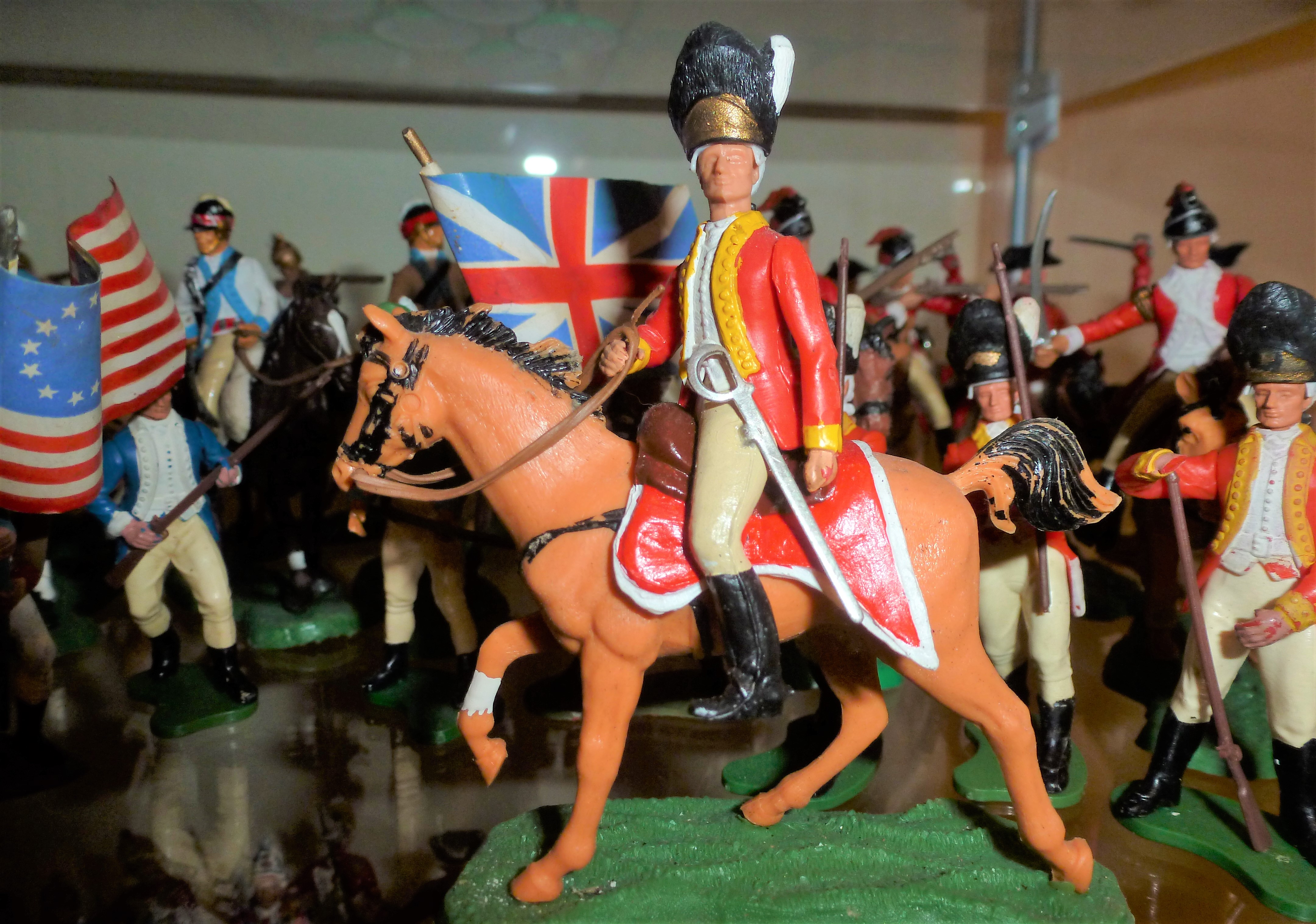
Britains American War of Independance Swoppets.

 This past year I embarked upon a review of how I store and display the unruly mass of toy soldiers accumulated in a largely haphazard way over the past six plus decades.  


Everything is being separated out between collectables and figures for wargaming, the former to stand safely on a shelf gathering dust and looking pretty, the latter boxed securely in their units and ranks ready to be deployed on the tabletop at a moments notice.


I started picking up Britains and Timpo American War of Independence Swoppets with the intention of using them for wargaming, back then they were the only figures available for the period, but they were hard to find and by the time I'd acquire enough they were getting too brittle and delicate for the amount of handling involved.  I aught to let them all go but I don't feel quite ready for that yet.


The building in the background is the tinplate "Revolutionary War Tavern" made in America by Louis Marx, the mounted figure of George Washington to the front left of it is an old composition piece made by Elastolin.


In amongst the Britains and Timpo Swoppet AWI are a smattering of figures from other manufacturers such as: Shell Liberty Men of '76, Louis Marx Warriors of the World, A Call to Arms, Res Plastics for Kinder Eggs, Awesome Toys, Casualties of War, Airfix, and a couple of white metal models.


The building shown here is the Louis Marx tinplate "Civil War Mansion" from their "Battle of the Blue and Gray" playset.


Native American allies are provided by Mohicans from Britains Herald range and Charbens.

 These figures have all spent far too long languishing in boxes so it was nice to get them out and put on display where I can appreciate them a bit more.

Tuesday, 30 July 2024

John Ruddle's Battleship

 On 6th December last year the Toy Solder Collection of the late John Ruddle was sold by C&T Auctions and I am told that the sale raised £100,000.  Here is a link to the online catalogue, compiled by James Opie, which in itself is a valuable resource for collectors of old toy soldiers: The Toy Soldier Collection of the Late John Ruddle Auction (candtauctions.co.uk)

But not everything went to auction; the wargame buildings, accessories, homecast figures and ships from his garden were considered unsuitable for inclusion in the sale, largely due to their condition, and were sold privately as a job lot.  After cleaning up and some repair most of the ships were sold through a collectors shop in Gosport, a Naval town just outside Portsmouth, where they were mostly snapped up by retired Naval officers as garden ornaments.  

  John had told me, some years previously, that he'd sold all of his model ships to a collector in Germany and I assumed he meant his garden battleships, naturally I was disappointed that I'd never see them again.  I realise now that he meant his collection of 1:1200 scale waterline ships, for which there is a much larger following in Germany, that made a lot more sense to me.  The last two garden battleships found their way to the London Toy Soldier Show last year so I couldn't pass up the opportunity to acquire one as a piece of iconic wargaming history.

John's ships have been shown before in various books and magazines but the photographs are mostly monochrome and set in larger views of his garden so I thought people might like to see a closer view.   

I don't know much about battleships so I'm hoping someone can tell me the class of this one.  John seems to have named his ships after actual vessels (although I recall a freighter named after the fictional "African Queen"), this one is HMS Rutlish, which I have been unable to trace any record of.

John was a maintenance engineer in the print industry and, while the ships are impressive from a distance, close up you can see that he bolted on all sorts of bits and pieces to build them.  

The superstructure lifts off and inside I found it had been fitted with an electric motor, so it might have been floated on a boating pond at one time, but there is no sign that a propeller shaft or screw were ever installed.  John had told me that he built his ships from aluminium sheet and that does appear to be the case with the deck, guns and bridge but the hull is made from fibreglass, a common enough material used by ship modellers and for DIY car repairs in the 1960's, but rarely used domestically since then.

This final shot of me holding HMS Rutlish is to give a sense of the size.  The paintwork is flaking badly, testament to years spent out in the garden and several repaints, I am currently struggling with the decision to burn off the worst sections and repaint or leave as is? 

Among the other items that never made the grade for the auction were a large quantity of silicon moulds that John used for casting his own figures and spare parts to repair and convert old Britains hollowcasts.  There was also a large collection of the actual figures he'd made and used in his garden wargames, being in the print industry he had access to ample supplies of lead, and created units which had never been covered by the toy manufacturers, including several units of what appear to be various Constabulary to police the far flung regions of his garden Empire.

Thursday, 5 October 2023

John Ruddle 1932 - 2023

 I don't normally buy Toy Soldier Collector magazine, because it mostly seems to be about reviewing new product, but flicking through the latest issue I noticed two articles of interest.


The first was a three page tribute to John Ruddle, who sadly passed away in February, written by James Opie, with photographs taken by Paul Cattermole.  John will be well known to most people who visit these pages due to his internationally renowned model garden, which has featured in numerous wargame publications down the decades.  I didn't know John well but he only lived about a mile away from me and kindly invited me over to visit on a couple of occasions.  He was a great character with an unbridled passion for the hobby, both collecting and wargaming with Britains 54mm hollow cast lead toy soldiers.

So much so that he had landscaped his garden to represent different continents complete with buildings built from concrete in the relevant styles of architecture.  The beds on the left represented Europe, with areas allocated to England, France, Germany and Italy, also a small area for Belgium which included the Mons canal.  The large lawn in the centre of the garden represented ocean, and John had made fleets of battleships which he'd cut out of aluminium sheet so that the wouldn't rust because they were left out all year round.  

If I remember correctly the end of the garden had a large rockery with a hill fort and village to represent the North West Frontier and Africa.  There were two ponds which fed streams representing rivers and the canal mentioned above, that ran through the countries.  There was also an O gauge railway, originally clockwork, John told me that when he had his house rewired the electrician was so taken with the garden he offered to electrify the railway, he installed a transformer and built a control panel for John to operate it.

On one occasion John was in the process of building a palace with harem for a Turkish Sultan, to be situated on a point between Africa and Europe.  He had laid out a square wooden frame on the ground and filled it with sand, into which he would make an imprint of the building facade, and then pour in concrete.  He explained that on some of his earlier buildings he'd had a problem with cracks in the concrete due to frost until a builder doing some work on his house advised him to add sugar to the mix to prevent this.  A lot of the buildings had removeable roofs so that figures could be stored inside them, nothing vintage but ones that he cast himself, and each year he would give their paintwork a touch up, he also had to spring clean the buildings because mice would nest in them over the winter!

The last time I met John was at the London Toy Soldier Show where Paul Morehead and I interviewed him about his memories of Major Henry Harris, but that's another story for another day.  He was also selling off part of his collection so I bought several units of German and Russian cavalry from him, he was very pleased that they would continue to serve in games on the table and in the garden.

Which leads me neatly on to the second article of interest and this is two pages written by Paul Holcroft Wright about the new edition of Funny Little Wars, a reworking of the original layout with all new illustrations and incorporating a lot more background to H.G. Wells.  I know that several other bloggers who visit here are fellow members of the FLW group and will already have the new edition but I couldn't pass up the opportunity to give it a mention.

Sunday, 26 March 2023

Battle of Vitoria (part 2) - A Napoleonic Battle Cry wargame

 Here are the rest of the pictures I took of last year's game of Vitoria, which Anthony played using the Battle Cry rules system.

The Highlanders have pushed the French back across the River Zadorra and now prepare to cross in the face of opposition from an Italian regiment.

The French come under pressure in the centre.........

........while things go from bad to worse on their right flank.

The French take a hard pounding in the centre of the line......

.......and the Highlanders break through to isolate their right flank......

.......and as the Allies cross the river in force it's all over for the French.

I got along to the Spring Model Show yesterday, this is the rebranded name for the March event formerly known as the London toy Soldier Show.  There is still a hardcore of toy soldier dealers while the slack has been taken up by sellers of model kits and modelling materials, the later were doing a brisk trade and it is hoped that this shot in the arm will enable the event to continue, certainly there was a good stream of buyers coming in through the door.

I took the opportunity to stock up on acrylic paints made by ICM in the Ukraine and a few other bits which will no doubt find their way onto this page in due course.

Thursday, 28 April 2022

More of the new display

I've been wondering which figures to display on the extra shelves I added to my IKEA display cabinet, this is what I've come up with so far:

Some Polish Lancers, the officer in the centre made in France by JIM, the troopers around him made in Poland by PZG (the Polish Association of the Deaf), beautiful figures destined to remain in the cabinet and not risk the rigours of the wargame table.

The Corsican Ogre himself, made by Cyrnos, the Mamelouk standard bearer made by JIM as are the Carabinier and Hussars behind them. 

The Duke of Marlborough, mounted by Cherilea and on foot made by Tradition, the Grenadiers in the background are repainted Cavendish figures.

A hotchpotch of American Revolution figures, many converted from old Britains swoppets and Helmet kits parts by Denis Donovan and Gareth Lloyd, who have established an enviable reputation for such work.

Friday, 7 January 2022

Unknown Hussar conversion from Britains hollowcast toy soldier.

 This is a conversion of an old Britains hollowcast toy Hussar into.... well another Hussar, but who or which Regiment does he represent?  

The horse's forelock, mane and tail have been built up with solder rather than a modelling clay, which we would use today, also a pelisse has been added to the rider from lead sheet.  The horse has been painted in gloss while the rider and saddle are in matt paint.


On the tail of the shabraque I can just make out VII, and it looks like his busby has been heightened to appear earlier than the Victorian style on the original toy, also there is a small hole on the top where a plume would once have been. Other additions are the stirrups and valise visible in this picture.


Someone has invested a lot of time and skill into making him and I'd love to know who that was, it's very much the sort of thing that members of the BMSS (British Model Soldier Society) used to make in the 1950's and 60's so I'll be putting these pics up on Facebook in the hope that one of the senior members of the hobby might recognise the handiwork and even be able to tell me who made him.

Monday, 26 October 2020

A Crimean One Hour Wargame.

 A few  weeks ago we decided to hold an impromptu socially distanced game before the Powers that Be extended the lockdown to prohibit meetings of more than one household again.  These are strange times. The 2 metre wide table and a few other simple measures ensured that proper social distancing was observed, it's not difficult when there's a will and common sense prevails.  

Scenario One, Pitched Battle, was selected from OHW and toys suitable to the Crimean War were quickly garnered together.  The scenario called for a minimal terrain, the British drew units of infantry, skirmishers and cavalry while the Russians were favoured with infantry, cavalry and artillery!  Here's how it went:

Without any artillery the Brits had little option other than to pitch straight into the attack before the Russian guns ground them down.  "Into the Valley etc. etc."

Threatened on the flank, the Cossacks charge home but are bounced off by the doughty Dragoons of the Heavy Brigade, an immediate counter attack sees the Cossacks dispersed and routed.

Russian regular Infantry and Rifles wheel about to enfilade the advancing British line, they deliver a devastating volley that shatters a Regiment on the English right.

The thin red line holds and delivers it's own volley, both sides are now taking punishment and the British skirmishers have been brushed aside.  Here the British deploy their long range measuring tape.

The Battle began to pivot as the British faltered on their left but made gains on the right, at this point honours were even and it was still anybody's game.

Having seen off the Cossacks the redoubtable Dragoons followed through and rode down a Regiment of Infantry, only to flounder beneath the Russian guns on the ridge.  The withering Russian fire now began to tell and the British attack ground to a halt.  

The game lasted 8 moves, probably the quickest we've played, usually we go the full 15 rounds, but at least we got a game in, it was good to see toy soldiers back on the table and who knows when the next game will be?

Wednesday, 22 July 2020

Early Toy Soldier Newsreels

Continuing my romp through the YouTube archives, here are a few more finds that I think are worth more than just one look.  It always surprises me that however much you trawl through YouTube every now and again something new surfaces, which has probably been buried away there for years.


Model Soldier Club 1939
Now this is a bit of archive footage I haven't seen before, it's an early meeting of the British Model Soldier Society.  Among the luminaries I spotted Otto Gottstein (in the opening shot, sitting at the far end of the table smoking a cigarette, next to a chap with a pipe) he was President of the Society at the time and a great patron of the hobby.  Also I think I see a young Deryck Guyler (at about 22 seconds in) who was a keen member of the BMSS before going on to be one of the founding members of the Society of Ancients.  The clip includes a rather nice selection of model knights produced by Richard Courtenay.


Model Soldiers 1953
I have Detlef Heerbrand to thank for finding this clip and posting it on facebook (which I finally got around to joining this month - a sure sign that it's days are numbered).  It features Bill Carman who was Vice Chaiman of the BMSS at the time and was one of the first to manufacture model soldiers for the collector.  His figures are a bit basic by modern standards but I've always been a big fan of them so I was particularly pleased when this surfaced.


Toy Soldiers 1949
Archive footage shot inside the Britains factory showing the hand casting of hollowcast figures, through to cleaning the castings, painting and packing them.


Toy Soldiers 1965
This piece of footage has been doing the rounds for a while but given that it's dated 1965 it's interesting that the commentary points out the hollow cast figures shown are made strictly for adults as collectors items. Britains ceased hollow casting in 1966, the story that this was because of lead paint and child safety fears is an urban myth, the truth is they just weren't selling enough.  The second half of the film shows an injection moulding machine being loaded up with plastic pellets and states that production of plastics was in full swing for the juvenile toy market.


Model Soldier sale 1968
This newsreel covered the very first specialist auction of Toy Soldiers (in fact the first specialist auction of any toys), held by Knight, Frank and Rutley who were founded in 1896 as Valuers, Surveyors and Auctioneers, they are a well known Estate Agents (Realtors).  I didn't recognise any of the faces amongst the crowd here but the toy soldiers needed no introduction.

Friday, 10 July 2020

Toy Soldiers of the Great War

An early birthday present to myself (because I'm worth it), "Les Petits Soldats de la Grande Guerre" has been out for while but I've only just come across it, the cover announces that it includes 800 toys of WW1 so I had to have it.


Published in 2013 by Editions Glenat, A4 format, it has 256 pages illustrated in full colour throughout, ISBN 978-2-7234-0700-2.  Written in French only but light on text so not too challenging for anyone with with a smattering of the language and a grounding in the Great War.  The pic below gives an example of the layout and quality of the illustrations.  The cover price is 39 Euro, which I would say offers very good value for a book of this size and quality, I got my copy on ebay France, new and still in the cellophane wrapping for 19 Euro plus 9 Euro P&P from seller "Book77".  Bargain!


There are 12 chapters looking at different aspects of the war, into which the toys are conveniently slotted.  The cover gives little away and I half expected the book to include every type of toy from diecast vehicles to dolls and teddy bears, but fear not, apart from a chapter containing tinplate tanks and ships the rest is all toy soldiers.  

You can expect to see the perennial favourites from Britains, CGB Mignot, and Elastolin  but they don't dominate, it's packed with figures of every genre: paper, flats and semi flats, conjoint tin, wood, hollowcast and solid lead, composition and even a little plastic and modern white metal (but not much).  The more I flick through it the more I enjoy it, I reckon you will too.


Wednesday, 1 April 2020

Queen Mary had some Toy Soldiers.

Queen Mary, wife of King George V, was an inveterate collector with a penchant for things miniature, and she was reported to be "extremely surprised" when it was suggested she be presented with a dolls' house as a gift from the Nation.  But this would be no ordinary dolls' house, it was to be designed by Sir Edward Lutyens, the architect responsible for building the Cenotaph in Whitehall, and would be furnished with contributions from all the major manufacturers and artisans of the day to promote the names and products of Britain's finest craftsmen.

William Britains, being the leading toy soldier manufacturer of the day provided a miniature example of a box of their toy soldiers for the dolls' house nursery, and they made a second set for the daughter of Frederick Britain, this is what it looks like:

The miniature set was never issued commercially and never featured in any of the catalogues or product lists.  In 1988 the second set was put up for auction by the Britains family and this postcard was sent by Phillips Auctioneers to collectors on their mailing list in the hope that one or more of us might have the odd ten grand to spare.  I attended the auction and the bids fell well short of the reserve, I don't know if it was subsequently sold by private treaty but have never heard anything of it since.  In fairness it's very difficult to put a value on a set like this which is literally unique, given that the set in the Royal collection will never come to market, and that in every field of collecting there are those individuals for whom money is no object!

Work on Queen Mary's dolls' house began in 1921, it was first displayed at the British Empire Exhibition of 1924 and is currently on permanent display in Windsor Castle (although at the time of writing it is closed until further notice).  

Saturday, 14 December 2019

Wargame at the London Toy Soldier Show

The internet blurb for the December show in London said it would feature a wargame arranged by James Opie and Replica Metal Soldiers & Models so I thought I'd take a look (well I was going there anyway for a Christmas get together with the lads)


The table was laid out for the Battle of Tell el Kebir, a good choice for a display game as it needs very little terrain (important if you're the one transporting the stuff) and the two sides are easily identifiable, Egyptians are in white, Brits are not.  I don't know the purpose of the bits of paper dotted all over the place but this sort of clutter on the table is a pet hate of mine.


Nice to see that I'm not the only person who resorts to mounting toy soldiers on 2p pieces!  Cavalry are mounted on lengths of transparent Perspex which are all but invisible, I was very impressed with the table mat which appeared to be just hand painted cloth but executed so much better than my own efforts.


I was told that the rules being used had been written by James Opie, based on Wells' Little Wars but with some modern twists (no matchstick firing cannon!).  It's nice to see a display wargame returning to the London Show but I do still miss the old Skirmish Wargames Group games.

James Opie was on hand at the nearby stand for C&T Auctions and was joined by Luigi Toiati who was promoting his new book "The History of Toy Soldiers".  Regulars at the London Show in the late 1980's and early 90's will remember the affable Luigi as the man behind Garibaldi Toy Soldiers, I've had his book for a while now but haven't had time to read through it (pictures look nice though) so a review will have to wait a bit longer.

In the meantime James and Luigi were promoting another new book "La dinastia degli Antonini a Roma" which is a privately printed history of three generations of  the Antonini family who have been making toy soldiers in Rome, their FIGIR composition figures are well known but not their lead creations so I've written to Santa for a copy, but as my emails to Rome haven't been acknowledged I'm not confident it will get here by Christmas!

Saturday, 9 November 2019

Battle of al-Musayfirah 1925 - One Hour Wargame with 54mm toy soldiers

We felt it was time to give the "One Hour Wargame" (OHW) rules by Neil Thomas another airing, Anthony and I both like the fast moving simplicity of this game system and it works well with 54mm toy soldiers.

Looking back through old copies of Wargames Illustrated for inspiration I found a scenario for the Battle of al-Musayfirah in 1925 during the Great Syrian Revolt.   After WW1 The League of Nations had given France a mandate to govern Syria and the French promptly instituted a number of measures to control the local tribes.  This inevitably lead to a nationalist uprising  by the Druze, which spread to the other tribes.


We chose scenario 15 from OHW, Fortified Defence, as it best reflected the actual battle.  Basically, a French Foreign Legion column was ambushed and badly mauled so the survivors took refuge in an old Turkish fort at Suwayda.  A relief column was prepared and an advance party sent forward to set up a defensive position at the town of al-Musayfirah as a staging post for the main column following behind.   A traditional colonial campaign in the finest traditions of P C Wren and Beau Geste, here's how it went:

On the left is the old Turkish fort at Suwayda, the town behind it in the rear centre is  al-Musayfirah, to the right of the town is a rocky area, in the OHW scenario this should be woods but rocks are more suitable for the desert so we just gave them the same terrain effect for movement and combat as woods.

We diced to see what forces each side would get, the French got 3 Inf, 2 Arty and 1 Cav, while the Druze got 3 Inf, 1 Heavy and 2 Cav.  That seemed to represent the original forces quite well, I wasn't sure what to use for the Druze heavy unit, in reality they had some artillery but I couldn't find any references to machine guns or other heavy weapons so a little imagination was called for.

The French start with one unit in the old Turkish fort at Suwayda and one in al-Musayfirah.  The Druze opened the ball with a mass attack on the garrison in the old Turkish fort.  Victory would go to whichever side occupied both the town and fort at the end of 15 turns.

The rules give the two garrisons additional firepower, which reflects the actual battle as the French had machine guns which took a terrible tole on the attackers.   To even things up the Druze have a refit rule which allows them to create a second wave with all their original units at their starting positions, rather like the Zulu wave mechanism we used in our recent Rorke’s Drift game.

The French cavalry came from the collection of veteran wargamer John Ruddle who created them from bits and pieces of old Britains hollow cast Spahis, all repaired and repainted.  Behind them the French Command are represented by Starlux mounted FFL.

The first wave of the Druze attack succeeds in overrunning the defenders in the fort and pushing back the relief column.  At this point they invoked the refit rule, leaving the fort abandoned temporarily while the second wave formed up for a renewed attack.

In the Druze second wave one unit has reoccupied the fort while the main push is directed against the garrison at al-Musayfirah.  Here the remaining infantry and Command, with heavy unit attached, use the cover of the rocky terrain to advance for a mass attack on the town.  The camel borne gun is the handiwork of Ross Macfarlane, as are the fort and town buildings.

The all out assault goes in, Druze mounted units rush the town while the foot provide covering fire from the rocks, will the beleaguered garrison hold out?

As we reached turn 15 and the end of the game, the superior firepower of the French forces carried the day.  A bombardment of the fort drove the Druze defenders out, leaving it unoccupied, while the mounted units caught in the open were wiped out by the French mountain artillery.

Anthony insisted we take a picture of the lunch, l'd like to tell you it was something suitably North African but clearly it's traditional beer and pizza.

The game played out very similar to the real battle, in 1925 the Druze suffered heavy casualties from the French machine gun strongpoints in al-Musayfirah.  They did manage to break into the town and promptly made off with all the columns horses and donkeys, but the attack through the rocks was broken up by a continuous bombardment from French aircraft.

Sunday, 28 April 2019

It's surprising what turns up.

The recent mild weather in the South East (UK)  has ushered in the start of the Car Boot Sale season a little earlier than usual.  Our local one is held on a farm, so it's a good long walk in the early morning fresh air, and I like to go along as often as I can for the exercise.  Who am I kidding, I go along for the bacon rolls and to hunt toy soldiers!   It can be very hit or miss but  here's what I picked up this week and last:

A group of modern white metal figures the first one depicting Captain Souter of the 44th Regiment of Foot could have walked straight out of the Last Stand at Gandamak painting by William Barnes Wollen.  The other five are from a range of 150 figures issued with the Hachette publication La legion Etrangere, available in France but not in the UK so they are harder to find here, I use them mostly for uniform research and at less than £2 each they had to come home with me.

I know nothing about old tin toys, except that I like them, and I do like to include them as set dressing in wargames.  The saloon car is about the rights size for 54mm toy soldiers while the Omnibus is a bit small but I think we'll get away with it, they both need a bit of cleaning up and straightening out but nothing too drastic.  I don't think there's any great age to them, they look like modern reproductions to me but for a couple of quid each they had to go in the bag.  Likewise the ceramic stable block which was made to take a tea light candle but will now illuminate my toy village.

Finally a hotch-potch of odds and ends that came in at about 50p each from various junk boxes.  The first three Britains/Herald Robin Hood figures are so damaged and scuffed that they will end up as conversion fodder.  The Evzone and horse from the Lone Star Lone Ranger figure will be passed on to someone else at the forthcoming Plastic Warrior Show next month.

The remaining two figures I'll keep, the chap in green is a Starlux character figure of Barberousse (Red beard) from the ORTF (Office de Radiodiffusion Television Francaise) TV series Richard Coeur de Lion.  The set was issued in the mid 1960's and included two foot figures each of Richard, Redbeard and Blondel and one mounted figure of Richard, they're quite hard to find.  The diminutive figure of Napoleon was made in France by MDM.  The palm tree is a modern white metal item.

The Plastic Warrior Show is being held on Saturday 11th May and further details can be found on the Plastic Warrior blog, link in the column to the left.  Good Hunting!