Showing posts with label Aquarium ornaments. Show all posts

Tuesday, 5 May 2026

Lineol, Elastolin etc. 1930's composition toy soldier display.

 Another display has recently made it to the shelves, this time 1930's Composition figures in combat poses, mostly made in Germany but also from France Belgium and Czechoslovakia.


On the left the tinplate vehicles crossing the bridge (Kubelwagen and Schwimmwagen) were made in Czechoslovakia by Gonio in 1992, they are 1/24th scale to match most German composition figures.  They are extremely well detailed with opening doors, folding windshield and accessories such as tools and weapons.  These two Axis vehicles came in different paint schemes for the European theatre, Afrika Korps and Medical variants.  There were also vehicles for the Allies; Willy's Jeep with trailer, Dodge Truck and M3 Half Track. 


In the Centre the attack is in full swing, machineguns give covering fire while the infantry charge home against the Allied trenches.


On the left, just in the nick of time reinforcements arrive to bolster the Allied line.  The cavalry and marching infantry to the rear left were made in Belgium by DURSO while the anti-aircraft gun and heavy trench mortar were made by Solido.


The anti-aircraft MG and loader (bottom right foreground) are in a hollow plaster material were made in France by DC - Domage et Cie, probably the most consistent and prolific of French toy soldier manufacturers.  They produced hollow lead figures from the 1920's and Aluminium under the name ALUDO (ALUminium DOmage) from 1937, during the war years 1939 to 1945 they made the figures shown above in plaster composition as metals were unavailable, post war they resumed production in metal until the early 1950's when they began to phase out the hollow lead range replacing it with acetate plastic figures under the name ACEDO (ACEtate DOmage).  The ALUDO and ACEDO ranges continued to be sold together through the 1950's with the aluminium figures being steadily phased out and ACEDO moving into more modern thermoplastics until production ended in the late 1960's.


Allied planes swoop in to straffe the Pioneers using flamethrowers to assault the Allied trenches.  


Support troops, Engineers and Signals get to work behind the assault units while Luftwaffe troops guard the airfield.  The two Fokker Triplanes are modern tinplate tourist items purchased in Greece and probably made in S.E. Asia, they are rather crude models but fit well with vintage composition figures.


Anti-aircraft fire hits one of the British planes and it crashes in No Mans Land (Elastolin made a very dramatic model of a plane crashing but this one is a modern resin aquarium ornament).


The General Staff observe the action and await reports from the front line, the two sturdy looking officers cameoed in the centre of shot were made by Kienel, a minor German maker who produced a range of high quality distinctive figures.


The tinplate machinegun (left foreground) and anti-tank gun (centre) are good examples of the camouflage pattern and colours used by Elastolin in the mid 1930's.


A pair of British infantry by Lineol drag a tinplate cart with machine gun, the officer behind them, scanning the skies with his binoculars was made by DURSO.


Right foreground, the telephone operator (headless!) and prone Officer with binoculars sheltering behind a log are copies of Elastolin poses made in Czechoslovakia by Durolin.  The large Elastolin explosion beyond them originally contained a small bulb wired to a battery to simulate the effect of the blast. 

There are some other composition figure displays to come; Parade and Bandsmen, Mounted, Medical and Campsite, 1920's and earlier, Wild West, Postwar Warsaw Pact, 54mm and Personalities.  It might just take a while to get around to them all.

Tuesday, 20 March 2012

The Battle of Astrakhan (part 1) – A RussoTurkish wargame with 54mm toy soldiers.

Back in 1993 veteran wargamers Stuart Asquith and Jack Alexander published a set of rules, called “Big Wars” for use with 54mm toy soldiers after the style of H G Wells “Little Wars”.   Big Wars retained the simplicity of Little Wars but introduced mechanisms that would be recognisable to the modern wargamer of smaller scale figures.  Over on the FunnyLittleWars Yahoo Group messrs IJ and AG began a discussion about Big Wars and I offered to umpire a game between them to try out the rules for a bit of fun.

The umpires overview of the table

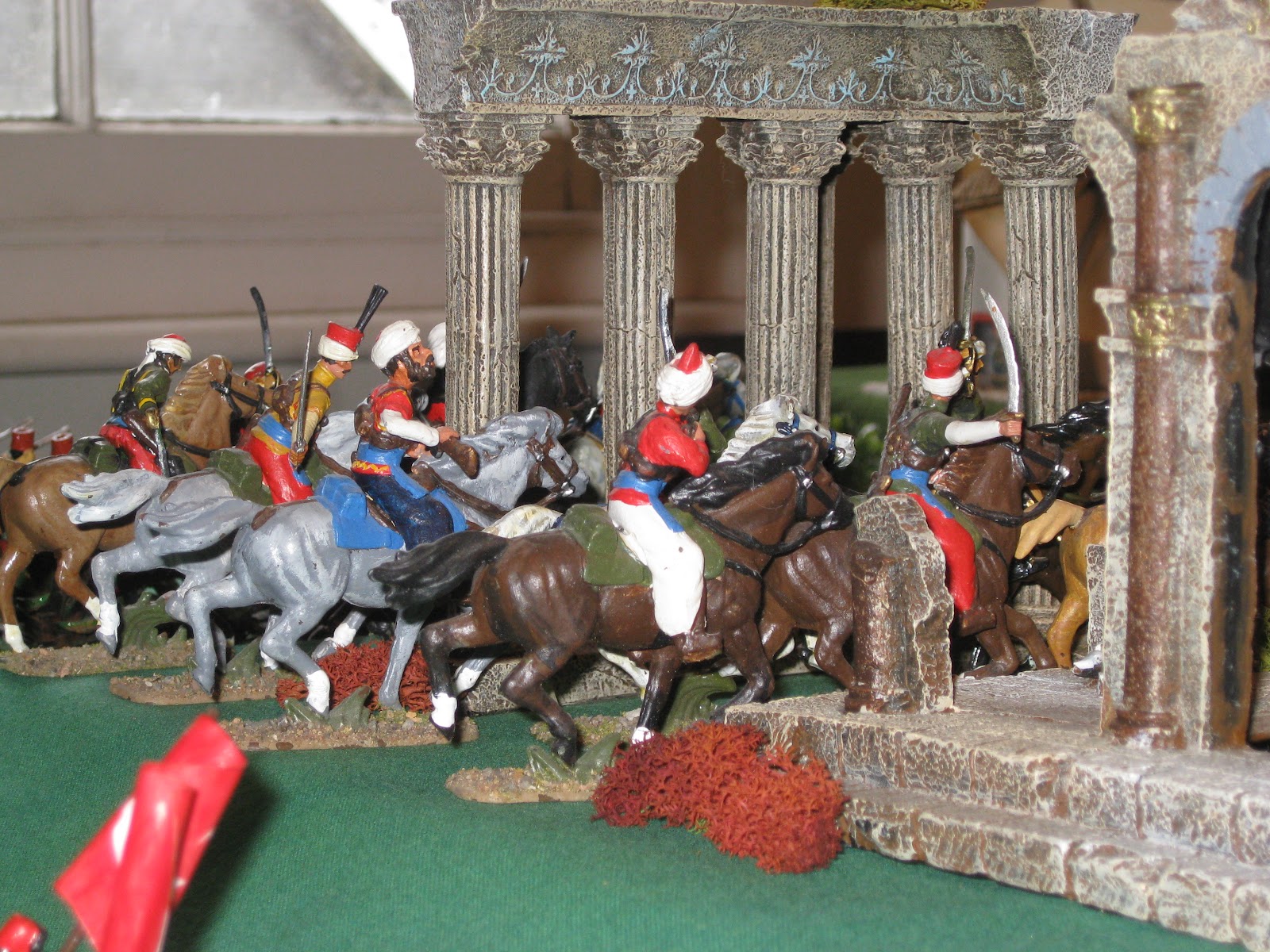
The initial dispositions, the Turks have concentrated to the south west of the field behind the cover of low hills and the ruins of a temple from an earlier civilisation.

The plan was that I would set up a terrain on my games table and allocate armies to each player.  H G Wells used to play his games on the floor and would rig up a curtain to go across the room so that each player could not see his opponents opening dispositions.  To emulate this I emailed Ian and Alan with photos of what could be seen at table top level from different points along their respective baselines.  The table measures 8’ x 6’ which we split into 6” squares annotated 1 to 16 along the length and A to L across the width so that the players could instruct me where to place their opening dispositions. 

To the north east the Russian forces prepare to occupy what appears to be a deserted village.

Infantry are formed in units of 10 plus officer and standard bearer, Cavalry comprise 5 troopers plus officer and an Artillery battery is 1 gun plus 4 gunners.  Each 6” square can accommodate two units of infantry or one of cavalry or one battery of artillery.  Infantry and artillery must start in a square on line A while cavalry can start from line A or B.  Units can also start off table but the player has to specify on which square they will enter the table.

The Turkish line begins it's advance

The background to the game is that the main campaign in the mountain passes of the Balkans has bogged down into siege and trench warfare around the city of Plevna.  To break the stalemate the Turks have sent a force over the Caucasus mountains in a raid to sweep across the Caucasian Plain, moving fast on a broad front living off the land and destroying everything in their path, emulating Sherman’s march to the sea during the American Civil War.

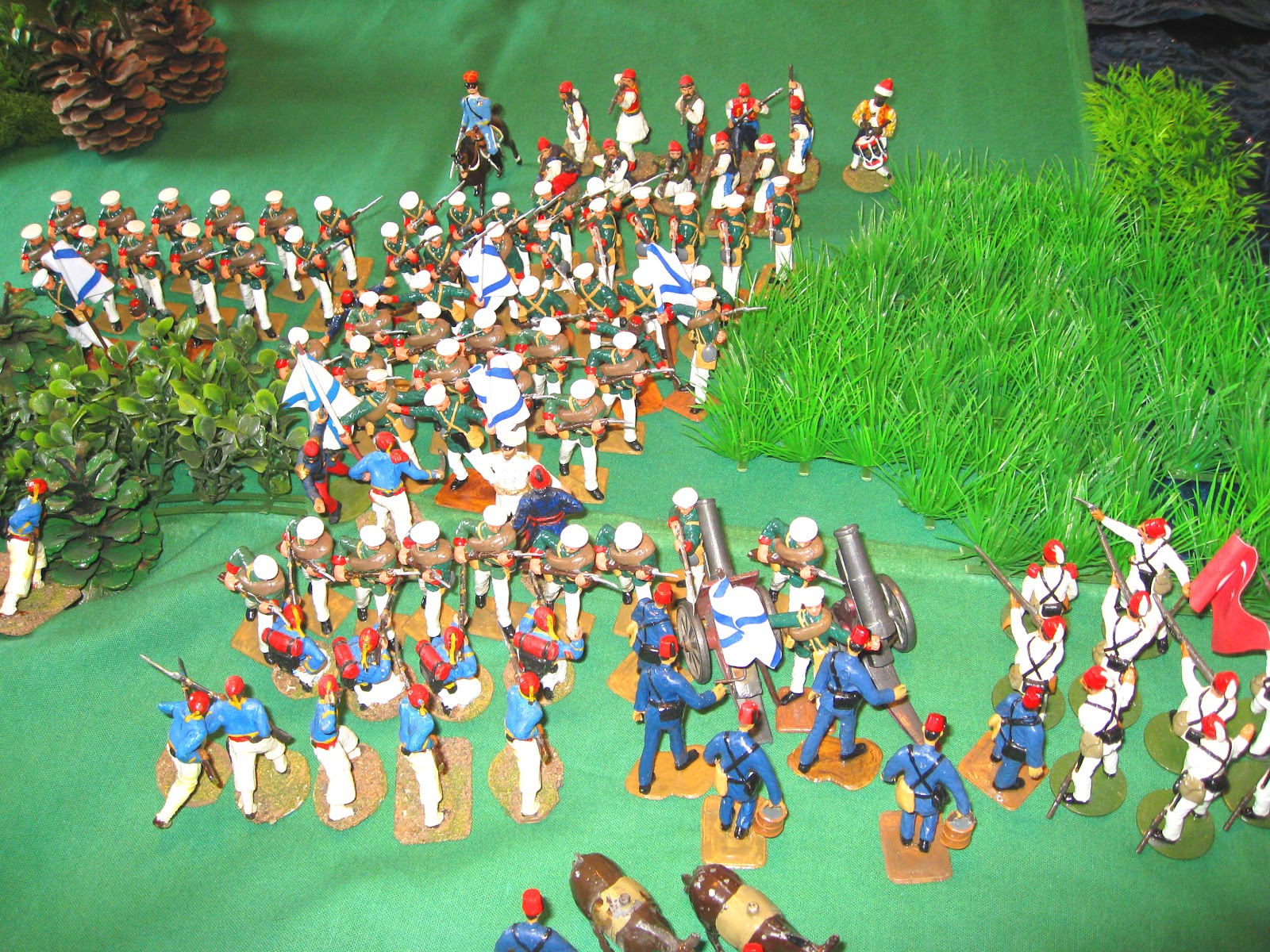
The Guard infantry, mountain guns and Naval contingent are deployed to the right flank.

Supported by mountain artillery, without any expectation of resupply or reinforcement their orders are to avoid pitched battle, march north in a feint towards Rostov then turn east avoiding Tsaritsyn (Volgograd) to attack Astrakhan from the landward while a naval flotilla makes a co-ordinated attack from the Caspian Sea.  Attached to the command are a group of Prussian advisers, veteran officers recently released from service after their victory in France, and a Naval contingent who will provide liaison with the flotilla for the attack on Astrakhan.

In the centre the Turkish light horse move to the crest of the hill.

The raid has two objectives, the first to draw enemy troops and resources away from the main theatre in the Balkans, the second to encourage a rising of the Kazakh and Uzbek cities of the Khiva Khanate, who have suffered the humiliation of Russian conquest in recent decades.  The capture of Astrakhan would provide a forward port through which they could be supplied with arms, the Cities are opportunists who will only back the winning side but it is hoped they will heed the call to jihad by their coreligionists but if that does not succeed the expedition will revert to bribery, it carries 30,000 pieces of gold provided by the British and American Governments who will are pleased to assist in any mischief which may cause the Russians some difficulty.

The light horse emerging from the ruins are conversions by Ross Macfarlane

Tomorrow, the Russians respond.

Saturday, 17 March 2012

The Battle of Astrakhan (part 3) - A Russo-Turkish wargame with 54mm toy soldiers

Continuing the battle played by email with 54mm toy soldiers using the "Big Wars" rules devised by Stuart Asquith and Jack Alexander.

For those who prefer the game of Imagi-Nations this started out as a conflict between the Sublime Porte of the Levant and The Balkan League, sadly due to my general lack of imagination we soon reverted to the historical scenario of the somewhat RussoTurkish intrigues and incursions of the late 1800's.
The Turks have set up a command post on the hill in the shelter of the ruins.

The Turks being concentrated to the west have begun a general advance of their entire line, their infantry command the heights, artillery cover the central plain between the river and the hills while their cavalry sweep into the valley.

The Turkish cavalry thunder across the valley between the Ancient Temple and Windmill Hill unaware of what they may face ahead of them.....or the Cuirassiers rounding the hill to fall on their right flank.

The Russian right wing is painfully thin, two regiments of infantry and two of cavalry facing an assualt by nearly three times their number......but they don't know this! 

The Turkish light horse career on in their wild charge.

Overview of the  field at moves 3 and 4.

The umpires view, shared with you dear reader but denied to the two players who can only see what is visible from the position of their commander at table top level.  The result of this is that their ability to judge distances on the table, the effect of terrain on movement and the actual position of some of their troops starts to become impaired.

The impressive advance of the Turkish line, the mountain artillery deploy.

The Russian right ambles forward in the lee of the hill unaware of the full force of the assault about to break upon them.

The Turkish artillery tries a ranging shot and finds it falls far short.

The Russian battery on the left replies and finds it's mark comfortably.

The second Russian battery in the centre on the line finds the range of the Turkish light horse with ease.

Commander of the Turkish forces, a Swiss emigre, Wolfgang Feyler with his Prussian advisors and the "Diplomatic Mission" Colonel Sharpe of the British Political Agency and Master Sergeant Harper of the United States Cavalry, with the "Diplomatic Bag".
The Caucasian Cossacks leave the village and prepare to swim their horses across the river to rejoin the main body.

Having discovered that the village is unoccupied and there appear to be no enemy troops opposite their left wing the Russians rapidly recall their troops back to the centre while the gathering threat on their right builds ominously.  Is this a knee jerk reaction?  Is the action on the right a feint to draw off Russian troops from the left so that Turks concealed off table can swoop in and occupy the village?  Who knows? ...it's a risk.

The Russians pour back over the bridge to rejoin the main body in the centre, the one small bridge proves to be a major problem causing a bottleneck as the men jostle with on another to get across.

The old bridge creaks and threatens to colapse under the pounding of hobnailed boots as the Russian conscripts are driven on by the blows and curses of their officrs. 

Desperately trying to buy time the Russian artillery on the left continues the counter battery work to deflect attention from the troops hurrying to get back to the main body. 

The Russian central battery continues to play on the Turkish cavalry charge trying to blunt the effect they will have when they hit the lightly held right wing. 

Tomorrow - which way will the combat turn?

Tuesday, 13 March 2012

The Battle of Astrakhan (part 5) - A Russo-Turkish wargame with 54mm toy soldiers

Continuing the battle played by email with 54mm toy soldiers using the "Big Wars" rules devised by Stuart Asquith and Jack Alexander.


The Russian infantry column masses for an assault in the centre.

The Turkish line holds steady........

........... as the attack of massed Russian infantry gains momentum.

The Russian guns soften the enemy line in support of the main assault........

.........but the Turkish guns reply...........

.........with deadly effect.

The Russian column veers to the right to avoid the marshy ground around the bend in the river.

On the Russian right the cavalry have reformed and prepare to charge across the valley to support the infantry attack

The Turkish infantry moves forward.

While the Russian column takes a punishing fire from the Turkish line.

The Russian column finally reaches it's goal.........

............but as the cavalry charge uphill to distract the enemy attention..............

...........they receive a withering volley which wipes them out

The Caucasian Rifles and Montenegrins advance but become disordered moving through broken ground.

On the hill the Russian staff watch in horror as the cavalry are blown away............

............but then a cheer goes up on the left as the infantry final charge home...........

........and overrun the Turkish guns.