Showing posts with label Tony Bath. Show all posts

Monday, 14 October 2019

1066 Otto Gottstein diorama discovered

On a recent visit to Hastings, land of Jack in the Green, Bonfire Boys, Grey Owl and all things 1066, I happened to mention to Mrs C that when I was a boy I regularly holidayed here with my parents and one year discovered a museum up on the cliffs which had a diorama of the Battle of Hastings. I could remember it clearly in my minds eye, it was massive, built on a table which filled the room and composed of tiny Airfix figures, the whole thing covered in a glass case.  But on subsequent visits I could never find that museum again, had I just imagined the whole thing?

And thus dear reader began the Quest!

We set off from the Pier, scaled the cliffs and with the aid of a map (a map! why didn't I think of using one of those before?) the museum was quickly found, smaller and less imposing than I remembered but it was in the right location, that was a start.  Inside.....no diorama, in fact hardly any mention of the Battle at all! (instead whole rooms devoted to Grey Owl and conservation).  As we gathered up our disappointment and made to leave I noticed a few figures behind glass, 30mm flats, not what we had come in search of and so poorly lit that you could barely make them out.

Descending the cliffs we returned to the Old Town and resumed our holiday, sampling local ales and poking around in the myriad junk shops until we entered what appeared to be a second hand book shop and in a corner at the back we found this:

In a large glass case but looking rather dull and dusty was this diorama of the Battle of Hastings, much smaller than I remembered and comprising 30mm German tin flats not 20mm plastic Airfix figures, sadly this couldn't be the diorama from my childhood.

I enquired about it's origin from Mr Dennis Collins, an elderly gentleman who seemed to be in charge of the shop, and he told me that it was indeed the diorama which had originally been housed in Hastings Museum up on the hill, the local borough Council had revamped the museum to make it a more interactive educational resource (oh, and also a venue for weddings and social events) for the community.  In this bright new vision there was no place for a big old box full of tiny tin soldiers so the diorama was broken up and put into storage, in due course the storage area was to be cleared out and the gentleman I was talking to had saved what was left from going in the skip. 

What remains is less than half, probably about a third of the original model, and without the centrepiece vignette of King Harold being shot in the eye by an arrow, which was retained by the museum and was the group of figures mentioned above that I had seen there.  Okay I can see that an old careworn exhibit isn't going to fit in with the needs of the modern world but I still felt it was an act of institutional vandalism, similar to what's been done at the National Army Museum (don't get me started on that)

I went back to take a longer look at the diorama to see how my memory could have been so misplaced, and then in the corner I noticed a small plastic plaque simply engraved D Stokes, London WC1 and I realised I was looking at one of the fifteen famous dioramas commissioned by the legendary collector, Otto Gottstein, for display in 1937 at the Royal United Services Museum in Whitehall.

 I didn't get a photo of the death of King Harold when I was at Hastings Museum, the display was just too dark, fortunately there is a monochrome pic of it in the 1937 catalogue for the RUSI museum exhibition.  And here it is, Harold is centre stage about to throw a spear and with a rather overscale arrow in the eye.

Above, the catalogue for the 1937 exhibition at the Royal United Services Museum in Whitehall together with the biography of Otto Gottstein and his collection (published by edition Krannich 2000, ISBN 3-933124-06-9, text mostly in German) well worth a read. 

Gottstein was a furrier who had fled Nazi persecution and settled in England, he was an avid collector of miniature figures and had commissioned several sets of Flats in Germany, in 1935 he became the first President of what was then known as the British Society for Collectors of Model Soldiers and subsequently renamed itself as the British Model Soldier Society (BMSS). 

 In 1951 Gottstein also financed Roy Selwyn-Smith's first venture, Selwyn Miniatures, he commissioned a set of high quality heraldic knights to be distributed exclusively in the U.S. where he had opened and office.  The initial commission was completed but sadly Gottstein died later that year and the Selwyn Miniatures moulds were sold to Britains who released them as the Knights of Agincourt series.

If you happen to be in Hastings do pop into Hastings History House at 21 Courthouse Street, it's the current home of this venerable old diorama as well as the HQ of Old Hastings Preservation Society.  I started to write this post some time ago then realised that as today is the anniversary of the Battle of Hastings, I really ought to get it posted.

Postscript.
After the RUSI Museum exhibition was broken up, the 15 dioramas were distributed to new homes far and wide, mostly military museums in the UK, one went to the Royal Military School of Music at Kneller Hall and has subsequently been lost, while no less than four went to the Glenbow Museum in Calgary, Canada - someone in Canada please tell us that they are still there!

Please do take a look at the Comments below where several people have left additional information and updates on the fate of the Gottstein Dioramas.

And Finally...... It transpired that this was not the diorama of my childhood memory but an earlier display which was subsequently replaced in 1966 for the 900th anniversary of the Battle by a much larger 18'x16' model built by eminent wargamers Donald Featherstone and Tony Bath who provided the figures.  


This is the diorama that thrilled me as a child, the photograph is taken from Donald Featherstone's book "Advanced War Games" and shows the author with Tony Bath (right foreground) using it to give a public demonstration of the Battle fought in 1066.  I could find no mention of the diorama in the text and have been unable to trace what became of it, I can only assume that at some point Tony Bath decided that he wanted his toys back?

Friday, 27 June 2014

Tony Bath - War Game of the Middle Ages and Ancient Times - part 2

So how did the rules work out?  Well I have to admit when I was drafting the quick reference sheet I had grave misgivings.  Players dice to see who goes first in each game turn, the winner moves, fires and melees, then the loser does the same, actions are consecutive not simultaneous.  Movement distances and terrain penalties are sensible and not over complex, the same goes for firing ranges and effect, so it's all fast moving.  So far so good.

The French Battle advances, crossbow companies in the lead followed by knights on foot and heavy infantry.  The mounted knights hold back while the footmen test the softness of the ground and clear a path through the English men at arms.

The only difficulty we had was with the melee system, the rules state that when a figure from one side moves to within half an inch of an enemy they create the "contact point" and that all figures within an infantry move (i.e. 12 inches) of said point are included in the melee. Seems straightforward but in practice so many troops are drawn in that it just becomes one almighty bundle, perhaps it works better with 30mm figures?

First blood to the archers, three companies of French crossbows get off the first string of arrows and annihilate the Burgundian bowmen.  Realising the threat of being unable to reply to the enemy archers the English light horse charge and catch them unsupported in open ground as they ride them down.

The melee is a two stage process, first you asses which side has won then you calculate the casualties.  And this is where the difficulty comes in, different troop types (see QR sheet at bottom of post) have combat values which vary depending on the troop types opposing them.  This is fine when both sides have the same troop types in the melee but with the 12 inch inclusion zone described above it is inevitable that you will have mixed arms (heavy/light cavalry, heavy/light infantry etc.) on both sides and we found it nigh on impossible to figure out who had won the melee, try it yourself and you'll see what I mean.  

To simplify the situation we broke the melees down into a unit on unit calculation rather than the 12 inch free for all and it seemed to work okay.  Once the winner has been decided, casualties are based on a simple calculation which ensures that the larger side always wins, very similar to the system in H G Wells "Little Wars"

The footmen of both sides lock horns as they slowly splash through the soggy marshlands.

In the melee we found that when the heavier armoured French eventually came to grips with the enemy they bludgeoned their way through the lines but the greater numbers and mobility of the lighter Allies meant that they could quickly plug the gaps to blunt their advance and wear them down by attrition.

Four companies of English men at arms hover like mosquitoes around the edges of the wetlands.

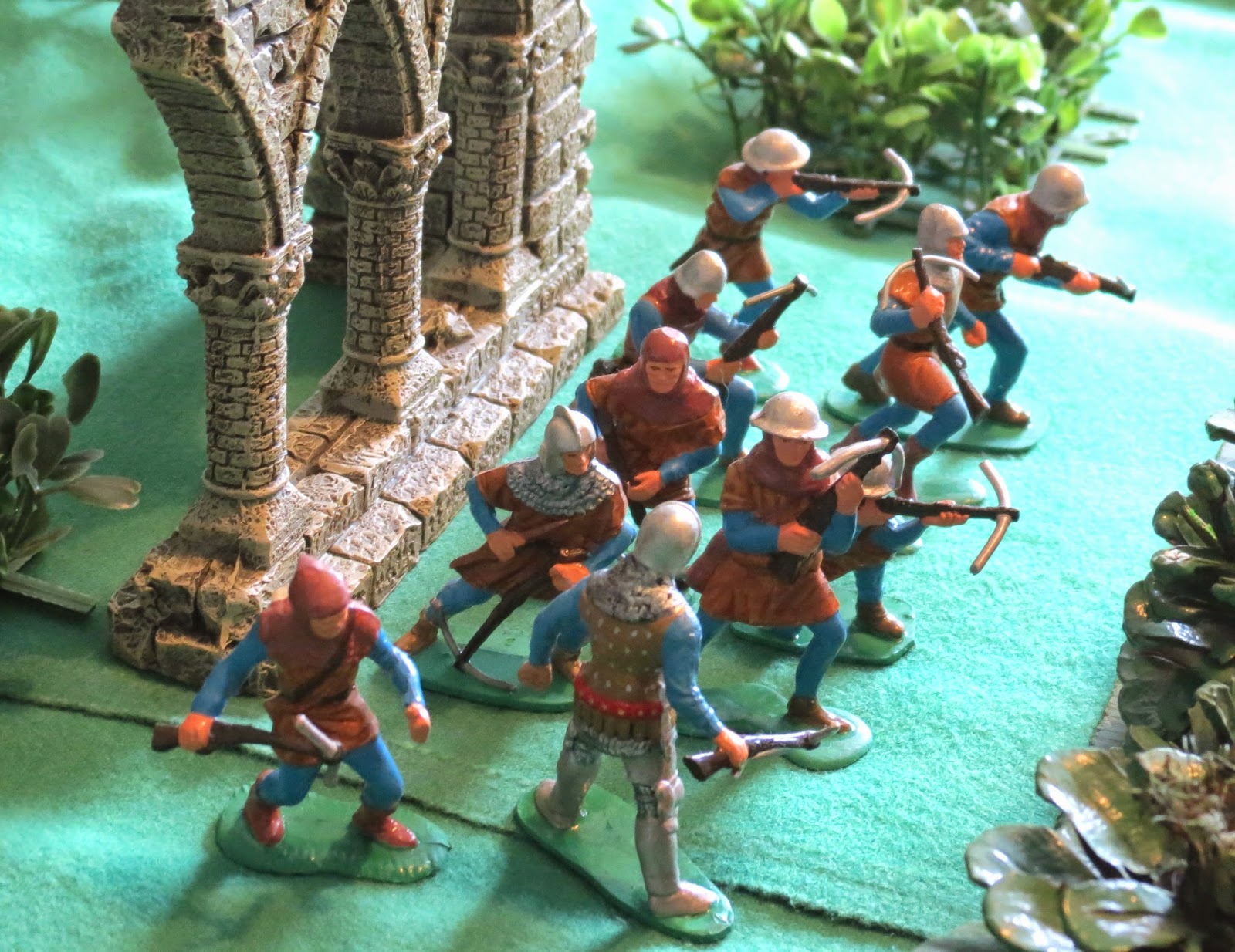
Over the years I've been picking up bits and pieces of Timpo knights on the cheap - a pair of legs here, a torso there, from the junk boxes at shows and when I started to put all the bits together I found I had a decent enough quantity to field an army with no painting involved.  The only drawback being that there is a preponderance of Crusaders which seem to have been very much more common.  The idea of using them as a Crusader army in the Holy Land doesn't really float my boat and I can't see me picking up enough Timpo Arabs to make that feasible so I have decided that any figure in a white tunic with a red Cross of St. George will be English.

After riding down the French archers the English cavalry have overreached themselves and are charged in the flank by the French heavies.

I think it's fair to say that some rather basic tactical errors were made on both sides, notably advancing archers unsupported in an attempt to close the range for them (I might consider extending the bow range to 3 feet in future games).  With the loss of all the archers the game turned to one of local melees erupting all over the field and with no morale rules to break the tension these became a fight to the finish slugfest.

The English numbers hold up well against the heavier strength of the French knights and both sides are worn down by attrition until the allies decide to slip away leaving the French in command of the field but too depleted to follow up.

So all in all a fun fast play game, we both agreed the rules worked well as the core of the system but they need a little bit more built around them like something to cause a unit to break and run or even refuse to fight.   Our aim was to play the to game as close as we could to the original rules, or at least our interpretation of their intention and I think we achieved that, although I would love to have tried them using 30mm flats.  This was just a trial run so we kept the scenario simple but tried to include as many of the troop types and terrain features as possible, the original manuscript offers additional features such as constructing earthworks, sieges, supply etc. And for the Ancients there are chariots and auxiliaries, all the more reason to buy the book (see last post)

The quick reference sheet for the rules, should anyone wish to give them a spin!  Oh I think I forgot to mention that the loser of a melee falls back 1 move, quite important that. 

Saturday, 7 June 2014

Tony Bath - War Game of the Middle Ages and Ancient Times - 1956

Following on from the Herring War game a few weeks back (see earlier post) AM and I made tentative arrangements to meet again across the table of  Mars, AM chose the period, Medieval, so I got to choose the rules.  I was a little surprised at the choice, but pleasantly so as I'd been spending a little too much hobby time working on the 17th and 19th centuries recently and a change is as good as a rest etc.


The lay of the land at the start of the game.  The flower of French chivalry confidently line the southern hills on the left while the bawdy English and their brutish allies the Burgundians are jostled into line along the northern slopes opposite, between them the marshes in the valley floor are swollen from the incessant rains

I mentioned in a previous post here that I had stumbled across the first set of wargame rules written by Tony Bath, founder of the Society of Ancients, in 1956 and since then I have been looking for an opportunity to try them out. 


The English lights - cavalry and infantry rush into the fray

There's something that appeals to me about the idea of using old rules for playing with old toy soldiers.  Now, my medievals don't hail from 1956, they're mostly from the 1960's, (well, some are) so not too far out. When I first read the rules I assumed they were written for 54mm soldiers because the movement distances were what I would expect for larger size figures and of course that was the type most widely available back then.  Also there was something about the game mechanisms that reminded me very much of Wells' Little Wars rules.


The well appointed French heavies - cavalry, infantry and swarms of crossbowmen begin a ponderous advance over difficult ground

Tony Bath actually used 30mm flat zinnfiguren which he imported from Germany for his games as the Ancient and Medieval periods were barely covered by the toy manufacturers of the day and this was long before the advent of the 20mm wargame miniature or even that pillar of the hobby soon to be known as Airfix.  By contrast the historical coverage of the flat manufacturers was, and remains, phenomenal.


Faced with the prospect of a charge from the heavy French horsemen, the English infantry make for the relative safety of the marshlands

Although the name of Tony Bath has become synonymous with the Ancient period it was to be several years after writing these rules that he founded the Society of Ancients and it is clear (apart from the title) that he intended them to stretch to cover at least the Hundred Years War as there is specific provision for "dismounted cavalry in full armour armed with shortened lance as used by the french at Poitiers".


The French crossbowmen have secured the ruined abbey

So, very much an old school game was had, with books under sheets for hills, pine cones for bushes, marshes hastily cut for the occasion from card and aquarium ornaments for ruins.  The Anglo-Burgundian force were mostly Timpo swappets with a hindrance of militia provided by Elastolin Saxons and stiffened by a phalanx of Deetail pikemen.  The French were mostly conversions, some painted in heraldic livery and finished in the toy style.


First blood to the French, the heavy cavalry on their right charges into the first line of Burgundian men at arms while a body of militia forms a hedge of pikes to protect themselves from the onslaught

We wanted to play the game as true as we could to the original rules without any tweaks and we could see that they depend on testing combat strength v mobility between the various differing classes of troops, so to give them a good first run out we made the opposing armies very different in composition.  The French were much heavier with greater firepower, about  30 heavy cavalry, 30 heavy infantry and 30 archers.  The Allies were much lighter but greater in number: 15 light cavalry, 60 light infantry, 10 militia, 10 heavy infantry and 10 archers. 


On the French left more heavy cavalry approach the marshes but are checked and look for firmer ground through them

I was given permission by the British Model Soldier Society to reproduce these rules for enthusiasts but before I got around to doing it I discovered they had been published as part of the History of Wargaming project, edited by John Curry, in Vol 4 - More Wargaming Pioneers so if you want to give this game a spin I would urge you to buy the book, it costs less than £12 and is part of a project that deserves all our support.  What I have done is produce a summary of the rules in a quick reference sheet which I will make available in the next post, but you really should still buy the book because there's a lot more in it.


The English men at arms jeer at the French knights from the relative safety of the wetlands egging them on to come forward

Thursday, 21 June 2012

Ancient Wargame - how does that work then?

Some years ago I came to the conclusion that painting 54mm Napoleonics and ACW for wargaming was a bit like cleaning out the Augean stables, the mountain of plastic never diminished and my hobby had become a chore instead of a pleasure.  To break the cycle I began searching for prepainted figures and bought up a clearance lot of the Timpo Romans made by Toyway (not to be confused with the original Timpo Swoppet Romans which would have required a remortgage on the house), these chaps are made of PVC so the weapons are a bit wangy and they plug in to a truly dreadful base which looks like a big orange dome.  Neither problem is insurmountable, dip the weapons in boiling water then straighten them and run under the cold tap - all sorted.  For the bases I reverted to my old favourite the tu'penny bit, the figures being PVC they stick to metal like barnacles on a boat hull, okay it's a bit of faffing about but it's not as tedious as having to paint 100 figures.

The Toyway/Timpo Romans, well detailed and nicely animated, I think the armour is quite accurate too.

I have never played an ancient wargame (not even with the Airfix figures I had as a lad) and my knowledge of the period extends little further than the Romans/Britons and Greeks/Persians but I have flicked through various Great Battles of ... and Great Commanders of .... type books so I know I am missing a trick and with that in mind I reached for the copy of Xenophon's "The Persian Expedition", which has been yellowing on my bookshelf these past two decades and headed for the local pub.

Britains Trojans, not the nice early Herald series figures but the later Hong Kong versions made of PVC (so I have no qualms about mounting them on new bases).  Will they pass muster as Carthaginians?  They'll have to because I haven't got anything else!

Xenophon's history of the Ten Thousand has provided me numerous scenarios which require few cavalry and no chariots or elephants, which is a good place to start as I only have infantry at the moment.  I have a reasonable number of Britains Trojans which will get the tu'penny treatment and be pressed into service as Carthaginians, supplemented by various African natives as ........ well Africans.

Rules?

I recently happened across some old copies of "The Bulletin" the magazine of the British Model Soldier Society but they were priced ridiculously high so I just bought one issue, July 1956 - the month I was born.  Flicking through I found a set of very basic Ancient/Medieval wargame rules written by a T L Bath, which appeared to be written for 54mm figures.  Enquiries on the Old School Wargames Yahoo Group showed that they were the first known rules written by Tony Bath who had founded the Society of Ancients and they were designed to be played with 30mm flat figures.

to be continued